Voxie is the text marketing platform trusted by top QSR brands like Sonic Drive-In, Inspire Brands, Jersey Mike’s, and PJ’s Coffee, just to name a few. Across these brands, Voxie powers programs like network-wide LTO launches, loyalty win-backs, and local offers that stay on brand and compliant.
The growing number of restaurant chains that choose Voxie has strengthened its standing as a thought leader in the franchise space; it’s currently an IFA Supplier Member and QSR Magazine has profiled its capabilities.
Voxie fits QSRs because one account covers corporate, regional teams, and every store. National programs and local offers run side by side under the same brand and compliance rules.
The Untapped Potential in QSR Text Marketing
While most QSR brands already text customers, only a fraction of them take full advantage of the channel’s potential. That gap grows more costly as guest relationships move to remote touchpoints. In William Blair’s December restaurant tracker, reported by QSR Magazine, off-premises dining made up about 70% of restaurant trips, and 79% of respondents said loyalty programs influence where they eat.
The programs that capture this potential tend to share a few traits. They pair local campaigns with national ones, trigger messages from guest behavior, and measure results against actual revenue.
Value Is in the Eye of the Customer: Understanding QSR Guest Priorities in 2026.
Example: Sonic’s Weekly LTO Program
Sonic Drive-In was promoting its weekly LTOs through email and app notifications, but results fell short. So Sonic added texting and sent the same LTO across all three channels. Text beat both.
| Metric | Result |
|---|---|
| LTO redemption rate with SMS | 3x |
| SMS redemption vs. email | 45% higher |
| SMS redemption vs. push notifications | 57% higher |
How Voxie Compares to Other Texting Platforms for QSRs
Most QSR brands already run some mix of email, push, loyalty, and CRM tools, so a new text platform has to earn its place alongside them. The table below shows where each option fits and how Voxie compares. The biggest differences come down to the tool’s infrastructure and support: one Voxie account spans headquarters, regions, and every store, and Voxie's team builds the integrations and leads the rollout.
| Alternative | Where it fits | Limitation for multi-location QSRs | How Voxie differs |
|---|---|---|---|
| Generic texting platforms | Single-location or single-brand texting | One account can’t model corporate, regional, and location layers | One brand account spanning every layer, with store-level reporting |
| All-in-one marketing platforms | Brands consolidating vendors across email, push, and SMS | Text is often one channel among many | Focused on text and multi-location operations, integrated with the existing stack |
| CDP and marketing cloud segmentation | Cross-channel customer profiles | Segments aren’t built around text-channel behavior | Text-specific propensity scoring layered on top of the CDP |
| SMS built into a loyalty platform | Basic messages to loyalty members | Limited governance, location reporting, and strategy support | Brand Standards, location-level reporting, and a dedicated team |
| Brand’s own mobile app | Brands wanting one branded guest experience | Building texting governance in-house is heavy | Read the case study about Sonic; they boosted LTO redemptions by using both push notifications and text. |
Who Voxie Isn’t Built For
Since Voxie is designed for US multi-location brands, it’s a weaker fit for:
- Single-location restaurants
- Brands operating outside the United States
- Brands wanting one vendor for email, push, and SMS
Why Generic SMS Platforms Struggle With Multi-Location Structure
Generic SMS platforms are designed around one team sending to one audience. But multi-location QSRs run on several layers at once, from corporate and regional teams to owner groups, district managers, and individual stores. Those stores may be franchisee-owned, company-owned, or a mix of both, and each layer needs something different from the platform:
- Corporate needs consistent brand voice, compliance at every location, and network-wide data.
- Locations need local relevance, simple tools, and visibility into their own results.
When a platform can only serve one side, brands usually settle for a compromise. Most QSRs end up having corporate send everything nationally. That keeps messaging compliant, but it gives up the lift local messaging drives.
Sonic Drive-In faced this exact tradeoff. On its previous platform, the brand shut down local texting entirely because it had no reliable way to govern what franchisees sent. After moving to Voxie, Sonic went from zero local texting to a fully governed local program built on Brand Standards and a staged rollout.
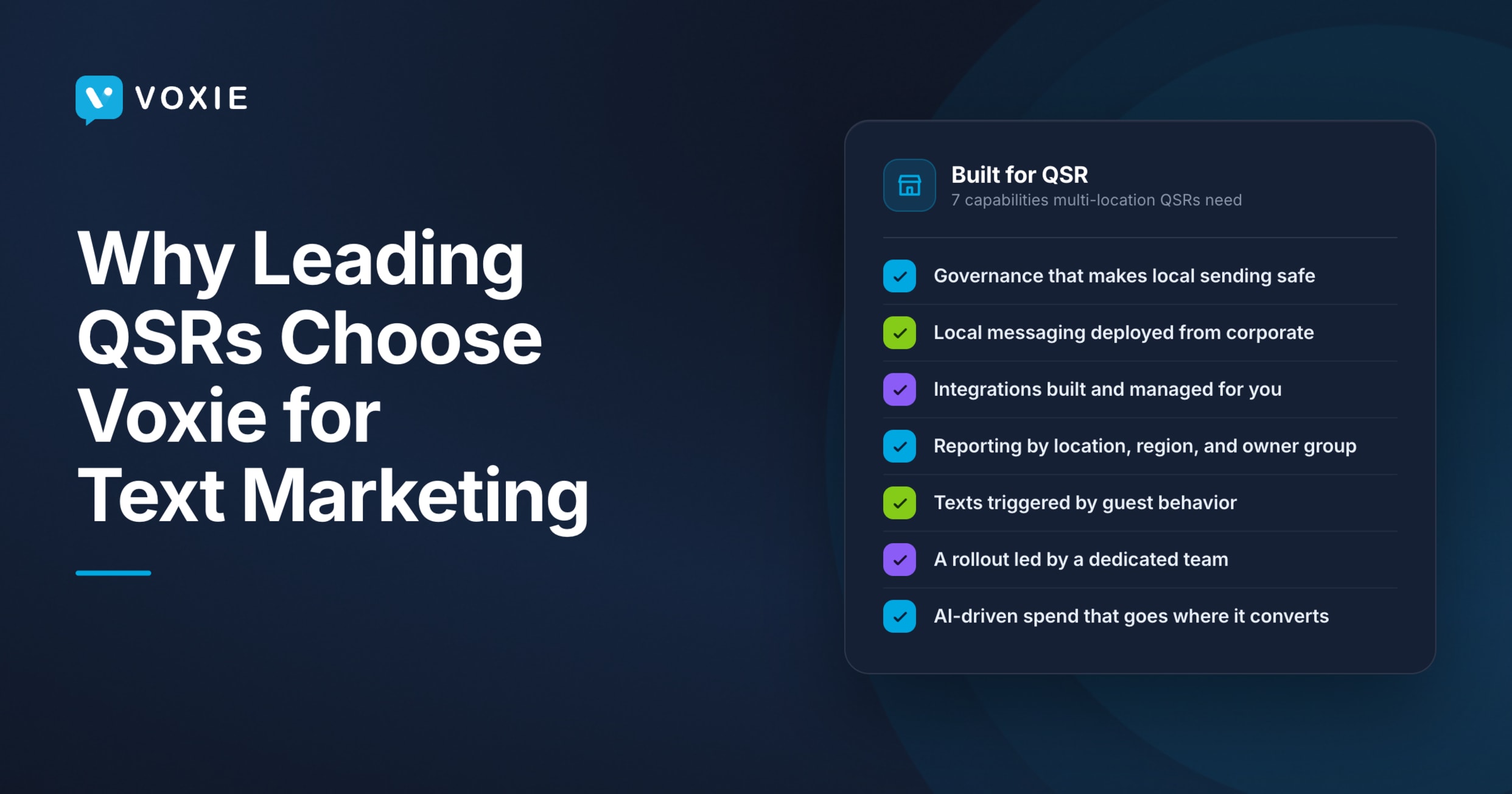
A text marketing platform built for multi-location brands lets QSRs avoid such compromises. In practice, that takes seven capabilities.
| Capability | Problem it solves |
|---|---|
| 1. Governance and compliance | Local sending feels too risky |
| 2. Localized messaging from corporate | National blasts feel generic to guests |
| 3. Managed integrations | SMS runs disconnected from POS and loyalty data |
| 4. Location-level visibility | Aggregate numbers hide weak locations |
| 5. Text flows triggered by customer behaviors | Not reaching customers when it matters |
| 6. A dedicated rollout team | Internal teams lack bandwidth |
| 7. Spend directed where it converts | Mass blasts waste budget |
1. Governance and Compliance That Make Local Sending Safe
Because local sending carries the most brand and legal risk, governance comes first. With Voxie, the QSR sets the rules once, and they apply automatically before any message is sent.
Brand Standards
Brand Standards lets the centralized marketing team decide what each location can send, when, to whom, and how often.
| Rule type | What corporate can set |
|---|---|
| Content | Pre-approved templates with locked elements, or free drafting with AI vetting |
| Frequency | Daily and weekly caps, minimum lead times, sending hours, corporate-only dates |
| Audience | Locations message only corporate-approved segments |
| Cost | Billing at the location level |
For locations allowed to draft their own messages, AI-powered content vetting flags off-brand language and compliance gaps before the campaign goes live.
Visibility Into Every Scheduled Send
Corporate QSR teams can view every campaign scheduled across the network, along with the ability to edit or pull any of them. That makes collisions easier to catch, such as a national LTO and a local promotion reaching the same guests on the same weekend.
Compliance Across Every Location
Text marketing falls under the TCPA, and carrier rules require A2P 10DLC registration for business messaging. Since one noncompliant text from a single restaurant can expose the whole brand, Voxie centralizes compliance so every location follows the same rules.
- Opt-ins and opt-outs are enacted in real-time
- A2P 10DLC registration is handled by Voxie
- Consent is tracked across every location
- Compliance-sensitive template elements stay locked
Opening Local Sending in Stages
Most QSR brands open local sending gradually to franchisees and locally managed branches. They often start with locked templates, so locations send approved campaigns with local details filled in. But, as operators prove themselves, the brand can move select locations to free drafting with AI vetting and keep adjusting permissions location by location.
2. Localized Messaging Deployed From Corporate
Most texts will still come from the brand team. Even so, every campaign can feel local, as the campaigns can:
- Send from localized phone numbers
- Store details filled in automatically
- Triggers by geography, time zone, or weather
- Each subscriber stays tied to their store
3. Integrations Built Around Your Stack and Managed for You
For most QSR brands, strategy-shaping data lives across a POS, a loyalty platform, online ordering, and a CRM or CDP. If the SMS platform can’t see those systems, it has no way to respond to a purchase, measure revenue, or tell a regular from a lapsed guest.
How Voxie Connects to Your Systems
Voxie integrates with many tools popular with QSRs, including HubSpot, Salesforce, and mParticle. If a brand's POS, loyalty platform, or other system isn't on that list, Voxie's team can scope and build a custom integration, working with the brand's IT team or vendor for access. Voxie's engineers also lead updates when those systems change.
What Connected Data Enables for QSR text marketing
With POS and loyalty data flowing in, the program can respond to what guests actually do:
- Purchases trigger timely follow-up texts
- Loyalty milestones prompt automated rewards
- Lapsed visits start win-back sequences
- Campaigns measured against actual revenue
- Results reported by individual location
- Two-way texting can answer customers’ questions
4. Visibility at the Location Level
Most QSR brands track aggregate numbers like total sends and overall click rates. But, when viewed nationwide, the data smooths over large differences between locations. A healthy network-wide conversion rate can include some stores converting at a fraction of the average and others performing several times better.
Reporting Built Around the Organization
Voxie organizes reporting around how the brand is structured:
- Dashboards by location, region, and owner group
- Campaign ROI tied to POS data
- Same-day data for mid-campaign adjustments
- Benchmarks comparing locations against each other
- Holdout groups measure true incremental lift
Holdout measurement compares guests who received a campaign with similar guests who didn’t, which gives the brand an incremental revenue figure it can trust.
5. Text Flows Triggered by Customer Behaviors
Common QSR Lifecycle Triggers
Every customer follows their user journey on their own timeline, not yours. Sending the right texts when it’s most relevant to them is a surefire way to increase engagement.
| Guest behavior | Automated message |
|---|---|
| New subscriber | Welcome and loyalty enrollment prompt |
| Points near a reward | Reminder to visit and redeem |
| Reward about to expire | Heads-up before it lapses |
| Member goes dormant | Re-engagement sequence |
| No redemption in a set window | Targeted incentive |
| Birthday | Loyalty reward on the day |
| LTO launch | Timed offer by location and daypart |
Example: How a Sandwich Franchise Re-Engaged 745,000 Lapsed Loyalty Members
A sandwich franchise with more than 2,500 locations enabled the right data integrations and worked with Voxie’s Customer Success team to reach loyalty members who hadn’t purchased in over 90 days.
| Detail | Result |
|---|---|
| QSR Audience | 745,000 loyalty members inactive for 90+ days |
| Offer | $3 off the next purchase, replacing the usual double-points offer |
| Timeframe | 5 days |
| Revenue return | $24 for every $1 spent |
| Attributed revenue | 164% increase |
| Conversion rate | 506% increase |
| Click-through rate | 5.5% |
The campaign showed that a tangible, time-limited offer outperformed the familiar double-points promotion with inactive members. Setting up the right tech stack data sharing proved to be the key; after the initial campaign to reach back all lapsed customers, win-back texts continued to be sent right when a customer crossed the threshold into “inactive.” Plus, because the campaign was tied to purchase data, the brand could measure that difference and carry the insight into future campaigns. Read the full case study.
6. A Rollout Led by a Dedicated Team
A rollout across hundreds of locations involves connecting systems, building the first programs, and training every location team. Any gap along the way shows up at the store level, so each Voxie customer gets a dedicated CSM who owns the rollout from start to finish. That includes:
- Building the initial messaging programs
- Configuring the platform and integrations
- Training location teams and tracking adoption
- Adjusting strategy as results come in
Here's how brand leaders at Sonic and Inspire Brands describe working with the team:
"Voxie's efficient onboarding made it easy for us to navigate SMS marketing and demonstrates how well they know our industry."
Ryan Dickerson, CMO, Sonic Drive-In
"The Voxie team is unmatched in their commitment to excellence in both their product and their people. They are highly responsive, agile, and consistently deliver on our evolving needs. The partnership feels like more than just a service provider relationship; it's been a true collaboration."
Richard Hesse, Manager of Technology Sourcing and Partnerships, Inspire Brands
7. Spend That Goes Where It Converts
Every LTO or promotional text sent to a guest who's unlikely to redeem adds cost without adding revenue. For QSR brands texting across hundreds of stores, that waste adds up quickly, so the audience for each send matters as much as the offer.
Voxie Intelligence
Voxie Intelligence is the platform's AI layer. It combines what it's learned from more than 1 billion analyzed text messages with each brand's own guest data to:
- Predict which guests will buy or lapse
- Forecast campaign ROI before sending
- Recommend segments and budget allocation
- Score micro-audiences at each location
QSR brands that already run a CDP or marketing cloud can keep it. The CDP groups guests across every channel, and Voxie adds a text-specific layer that scores which guests are likely to act on a given campaign at a given store.
Budget Optimizer
Budget Optimizer turns those predictions into a plan, with two starting points:
- Budget-first: Set a spend, and the platform identifies the audience most likely to convert.
- Audience-first: Start with a segment, and see where returns begin to taper.
In franchised systems, billing can also be routed by location or owner group. Franchisees fund their own local campaigns, and the brand team funds national programs.
QSR Marketing: Fresh Tactics for Fast-Food Restaurants.
The Main Takeaway for QSR Brands Considering Voxie
What sets Voxie apart is structural. One account models the full organization, from corporate to every store, so national programs and local offers share the same rules, data, and reporting. Corporate keeps the brand and compliance consistent, and each location stays relevant to its own guests. Every campaign traces back to revenue by store, and Voxie’s team builds the integrations and leads the rollout that get the program to every location.
Book a demo to see how the platform maps to your locations and loyalty program.
Frequently asked questions
What is Voxie?
Voxie is an SMS and MMS marketing platform built exclusively for franchise and multi-location brands. The company is headquartered in Atlanta, Georgia.
Is Voxie built for QSRs?
Yes. QSR is one of Voxie’s core industries, and the platform serves franchised, company-owned, and mixed multi-location QSR brands. It supports QSR-specific programs like LTO cycles, loyalty re-engagement, and coordinated local and national campaigns.
Which QSR brands use Voxie?
Restaurant brands on the platform include Sonic Drive-In, Inspire Brands, Jersey Mike’s, PJ’s Coffee, and D.P. Dough.
Does Voxie replace my restaurant’s loyalty program?
No. Voxie connects to your existing loyalty platform and uses its data to trigger rewards, reminders, and win-back messages.
Which POS and loyalty systems does Voxie integrate with?
For systems outside that list, including many POS and loyalty platforms, Voxie's team can build a custom integration as long as the platform has an open API.
Who handles the integrations?
Voxie's engineers build and maintain the integration. Brands typically provide API access and sign off on which data flows, so the project doesn't depend on internal engineering bandwidth.
Do locations have to send their own texts?
No. Corporate can run every send centrally, offer locations a set of pre-approved campaigns, or let franchisees and store managers draft within Brand Standards.
How does Voxie handle TCPA and A2P 10DLC compliance?
Voxie manages opt-ins and opt-outs at the corporate level and handles A2P 10DLC registration. Compliance-sensitive template elements stay locked, which keeps any single location from sending an off-policy message.

About the Author
Ali Spiric
Growth Marketing Manager at Voxie
Ali Spiric is the Growth Marketing Manager at Voxie, an SMS marketing platform built for franchise and multi-location brands. Her work puts her in daily contact with the campaign data, customer results, and messaging trends shaping how franchises use text. She has 7+ years of marketing experience focused on measurement and revenue attribution, and her writing has been cited in Forbes.