Most franchise brands collect customer feedback and then watch it lose its meaning on the way up. Responses to a text survey from hundreds of locations get pooled into one national score, and the local detail a franchisee could actually act on gets averaged out of existence. A new menu item lands well in Phoenix and flops in Boston, the dashboard shows a tepid 6.5 out of 10, and that number describes neither location and helps no one.
Texting fixes the parts of that process email and web forms can't. It reaches people in a place they check constantly, it gets read within minutes, and it lets a reply land somewhere a local owner can do something about it this week. This playbook covers how to send surveys via text, sometimes called SMS surveys, that get acted on: which surveys to send, how to design them, where the compliance lines sit, and how to keep the results useful at the location level.
The franchise feedback gap: national data, no local nuance
For a single-location business, survey results are simple: one store, one set of customers, and one score that means something. Franchises lose that clarity the moment results roll up. Feedback gets collected across hundreds of locations and reported as one brand-wide average, and averages hide exactly the information franchisees need.
Consider a regional chain running a satisfaction survey after every visit. Corporate sees a stable score quarter over quarter and concludes things are fine. But underneath that flat line, a dozen locations are slipping while a dozen others improve, and the two trends cancel out on the chart. The struggling franchisees never see their own numbers, and the reporting structure hides the pattern from corporate.
The fix is to keep each response tied to its source: which location, which customer, which interaction. Stored that way, the feedback stays actionable for both the local owner and corporate.
Why SMS surveys beat email and web forms for feedback
People read texts
Email open rates sit in the low double digits for most brands; texts are opened by the large majority of recipients, usually within minutes. An unopened email survey collects nothing, and plenty go unopened.
People already converse by text
Customers text constantly, with friends, family, and increasingly with the businesses they use, so replying to a survey text feels natural in a way a web form never does. That comfort produces fuller answers: instead of a tapped star rating, you get a sentence on why the visit was good or bad. The number gives you a score, the written reply gives you the reason, and over text people will actually write it.
Immediacy lets you time the ask
Because texts get read almost as soon as they arrive, you can survey at the moment that matters, right after the appointment, the meal, or the pickup, while it is still fresh. Email makes you hope the message gets opened over the next few days, by which point the memory has faded.
What response rate should you expect from a text survey?
Published response-rate figures for text message surveys vary enormously, from the 45% to 60% cited by some marketing reports down to roughly 11% to 13% in Gallup's testing of text-based survey outreach. Read these as directional: text reliably beats email for feedback, but treat any single headline percentage as a vendor's best case rather than a guarantee for your brand.
Feedback texts that do more than measure
A text survey does two jobs. It measures how customers feel about a visit, and requesting feedback over text can also collect data that makes your next message more relevant. That second job is the one most survey advice skips.
Preference and discovery surveys
Instead of asking only how the experience rated, ask what the customer wants to hear about:
- Ask what they want to hear about. "Want first dibs on limited-time offers, or updates on our after-school events? Reply LTO or EVENTS."
- Let them vote on what comes next. "We're testing two new flavors next month. Reply 1 for brown butter pecan or 2 for blackberry lavender."
- Find out which service interests them. "Which service are you most interested in? Reply LAWN, PEST, or BOTH."
The flavor vote tells the menu team what to launch, and it tells the customer their opinion counts. Every answer is also a fact about that specific person, and that is what makes the next part work.
This is where the collection tool matters. In Voxie, the answer can write to a contact's profile through Contact Custom Attributes and add them to the matching segment automatically: say LTO, and you land on the limited-time-offer list. Over time the surveys build self-selected audiences of people who told you what they want. Because each person asked for the topic, your targeting is sharper and the opt-in is on record.
Measurement surveys
These are the familiar ones most teams already run:
- NPS (Net Promoter Score) is the standard read on loyalty.
- CSAT (Customer Satisfaction) is the tactical read on one interaction.
- CES (Customer Effort Score) gauges how easy it was to get what they needed.
- Post-visit and win-back checks re-engage customers who have gone quiet.
Designing an SMS survey people actually answer
Keep it to one to three questions
A long survey text overwhelms the reader and tanks completion. If you need depth, that is a signal to use a link (more on that next), not to cram ten questions into the thread.
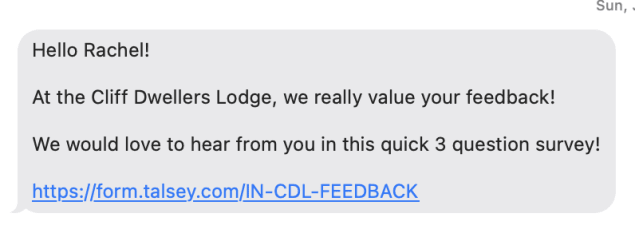
Cliff Dwellers Lodge does this well by naming the length up front. Telling the customer it is "a quick 3 question survey" assures them the burden is near zero before they tap.
Capture a number and a phrase
Lead with something fast to answer, a 1-to-5 or 0-to-10 scale, then invite an open reply: "What's the one thing we could do better?" The number gives you a trackable score, and the written reply tells you why. The two together beat either alone, and over text people will actually write the sentence.
Use a consistent scale
If one location asks 1-to-5 and another asks 1-to-10, the roll-up is meaningless. Standardize the scale across the brand so the numbers compare.
Lead with the ask, not a preamble
Open with the question itself, not a sentence of throat-clearing about how much you value their opinion. On a small screen, the question should be readable without scrolling, so a customer can answer in the time it takes to read it.
Time the ask by survey type
CX practitioners settle on a few rules of thumb, and timing varies by type:
- Send CSAT within roughly 24 hours of a specific interaction, while it is fresh. Stretch that to one or two weeks for anything that has to arrive first, like a delivery.
- Send relational NPS on a slower cadence: quarterly for B2B, semi-annually for consumer brands. Apply a suppression window of about 90 days per contact so you are not over-surveying loyal customers.
- Do not fire an NPS after every support ticket; that is what CSAT is for.
There is no settled best time of day. Studies name different days as the winner, so test your own audience instead of trusting a blanket rule.
The compliance line franchises can't cross
Feedback texting sits on a legal line, and crossing it is expensive. Keep these rules in view:
- A pure feedback survey generally reads as transactional. Asking "How was your visit?" with no offer attached is informational, the safer footing.
- Attach an incentive and it can become marketing. "Take our survey and get 10% off" turns a transactional message into a promotional one under stricter consent rules. Rewarding a rating also biases the score.
- Marketing texts require prior express written consent. Under the TCPA, that means written consent with the customer's signature and a clear disclosure. Statutory damages start at $500 per message and rise to $1,500 for willful violations, and real settlements often run higher, so it adds up fast across a list.
- Mind the sending hours. Send only between 8 a.m. and 9 p.m. in the recipient's local time. For a brand spanning time zones, that means sending by the recipient's zone, which Voxie's time-zone sending handles for you.
- A franchisee's mistake can become the brand's problem. Depending on the franchise relationship, one location's slip can create exposure that reaches the brand. Centralized opt-in and opt-out control, plus locked templates, lower that risk. Voxie manages opt-outs at the brand level, so an opt-out can apply across every location's number.
When in doubt, keep feedback surveys clean of offers, and route any promotional follow-up through your marketing consent. Voxie's TCPA compliance checklist for SMS walks through the details. None of this is legal advice. Run the specifics by your lawyer before you launch.
Craft the text to lift response rate
A few copy choices reliably pull more replies, whatever the survey type:
- Personalize the opening. Use the customer's name and their local store, so the text reads like a place they know, not a corporate list.
- Add a deadline when it fits. A cutoff creates urgency and pulls responses forward.
- Make the next step obvious. "Reply 1 to 5" or a single tap removes the guesswork.
- Keep it local. Reference the location and send from the local number, so the ask feels tied to the visit.

REI's member-survey text shows two of these in action. A firm deadline ("Ends 3/15") adds urgency, and asking members to help shape "the co-op" makes a national request feel locally owned. A franchise can go further by sending from the neighborhood location's own number, so the local feel is real, not implied.
Reply-in-text or send-to-a-link?
Reply-in-text (native)
The customer texts back "5" or a sentence without leaving the conversation. It is the lowest-friction option, and it suits high-frequency pulse checks like NPS, CSAT, or a quick preference vote, where you want one answer fast. Native replies are fast and get strong response rates on short surveys. For a franchise there is a further benefit: the answer stays in the two-way conversation, where it can be read for sentiment and routed to the right person. The limit is length, since native only works when the survey is genuinely short.
Send-to-a-link
A link buys depth a text thread cannot hold: multiple questions, multiple-choice grids, images, skip logic. The cost is friction, since every required tap is a place people abandon. And the link does not automatically win on response. Gallup found text-to-web and text-only surveys at similar response rates, with slightly more drop-off on the longer version. The extra step buys question depth, not participation, and risks losing casual responders.
As a rule of thumb, use reply-in-text for one or two questions and a link for a real questionnaire. For franchises, default to native when you can, since keeping the reply in the thread is what enables understanding, routing, and local action. A reply that lives in a separate survey tool is harder to act on than one inside the SMS survey thread, because it sits outside the conversation.
Understand and route every reply
The replies pile up fast, and most are messy: rambling, emotional, half-finished sentences that bury the point. Plenty of feedback programs collect thousands and never work through the inbox.
Read open-text replies at scale
Customers do not answer in tidy data points. They vent, they digress, they bury the real complaint in the third sentence. Voxie's Sentiment Analysis is designed to read tone and implied context, so a messy paragraph in the customer's own words can be sorted into a usable signal rather than left unread.
Route by sentiment
Not every reply deserves the same next step. A happy customer is a referral or review waiting to be asked for; an unhappy one is a recovery clock ticking before a public one-star review. Set up the rules once, and Voxie's text automation can route a positive reply toward a testimonial or referral ask and a negative one toward fast follow-up from the right person at the location, while the moment is still live.
How Voxie turns franchise feedback into a system
Most texting tools assume one business with one set of customers. A franchise is a network of them. That structure is what makes Voxie work as a text survey platform: feedback survives the trip from a single reply to a brand-wide decision and back.
Collect in the local voice
Sent from the location's own number, the survey reads like the neighborhood store, not a corporate blast. Customers answer in their own words, and Conversational Intelligence reads tone and context to route what they say.
Turn answers into segments
Preference answers become segments, so the survey builds your audience. Centralized consent control and locked templates keep franchisees compliant.
See results by location and across the network
When feedback is organized by franchisee and location, you see what a single national average would hide. Owners get their own location's scores and comments to act on this week, and corporate is able to identify both nationwide trends and outliers, positive and negative. Feeding that data into other BI platforms lets franchises connect a change in scores to the decision or event behind it.
A feedback program can stop at a quarterly chart nobody opens, or it can capture what customers want, route it to the people who can act locally, and check whether the fix worked.
If you want to see how SMS surveys work for a multi-location brand like yours, schedule a demo with Voxie and we will walk through it with your locations in mind.

About the Author
Ali Spiric
Growth Marketing Manager at Voxie
Ali Spiric is the Growth Marketing Manager at Voxie, an SMS marketing platform built for franchise and multi-location brands. Her work puts her in daily contact with the campaign data, customer results, and messaging trends shaping how franchises use text. She has 7+ years of marketing experience focused on measurement and revenue attribution, and her writing has been cited in Forbes.