Restaurants have gotten very good at one thing when it comes to loyalty programs: convincing customers to join. Between welcome bonuses, in-store prompts, QR codes on receipts, and app download incentives, the enrollment machinery has never been more refined.
And then, for some brands, the work stops.
This attitude is backwards, as acquiring a new restaurant customer costs 5-7X more than retaining an existing one. Every dollar spent keeping a loyalty member engaged and active goes measurably further than a dollar spent replacing them.
While a well-structured reward system is nonnegotiable, the loyalty programs that win are those that stay top of mind between visits. After all, with a reported 79% of customers saying loyalty programs influence dining decisions, your restaurant won’t be the only one clawing for customers’ return business.
Ultimately, success depends on an airtight communication strategy that has evolved beyond merely sending “mass blasts.” Data shows that the true pay-off in retention and revenue comes from tailoring messaging to the individual customer so the content is both relevant and personal.
The Restaurant Loyalty Member Lifecycle: Where Engagement Commonly Breaks Down
Most loyalty members are engaged during the first week or two after joining, commonly referred to as the "honeymoon" window. Then activity drops off, often fast.
The average annual activity rate across loyalty programs is estimated to be between 54% and 59%—depending on your source—with almost a third of members dropping off without ever using their points.
This drives home the point that enrollment doesn’t automatically lead to active participation. Common reasons why QSRs and other restaurants see such dramatic disconnects?
- No perceived value beyond the initial sign-up. They joined for the welcome offer and never saw a reason to come back to the program.
- No onboarding follow-through. Without a sequence reminding them why they joined and what to do next, the membership fades from memory within days.
- Too much friction in earning or redeeming. If the program takes more than a sentence to explain, most members won't bother figuring it out on their own.
- Generic, one-size-fits-all messaging. When every member receives the same blast, nothing feels relevant enough to act on.
- Too much silence between touchpoints. Time passes, no communication arrives, and the program quietly disappears from their routine.
Hook Loyalty Members Back Right When They're on the Cusp of Losing Interest
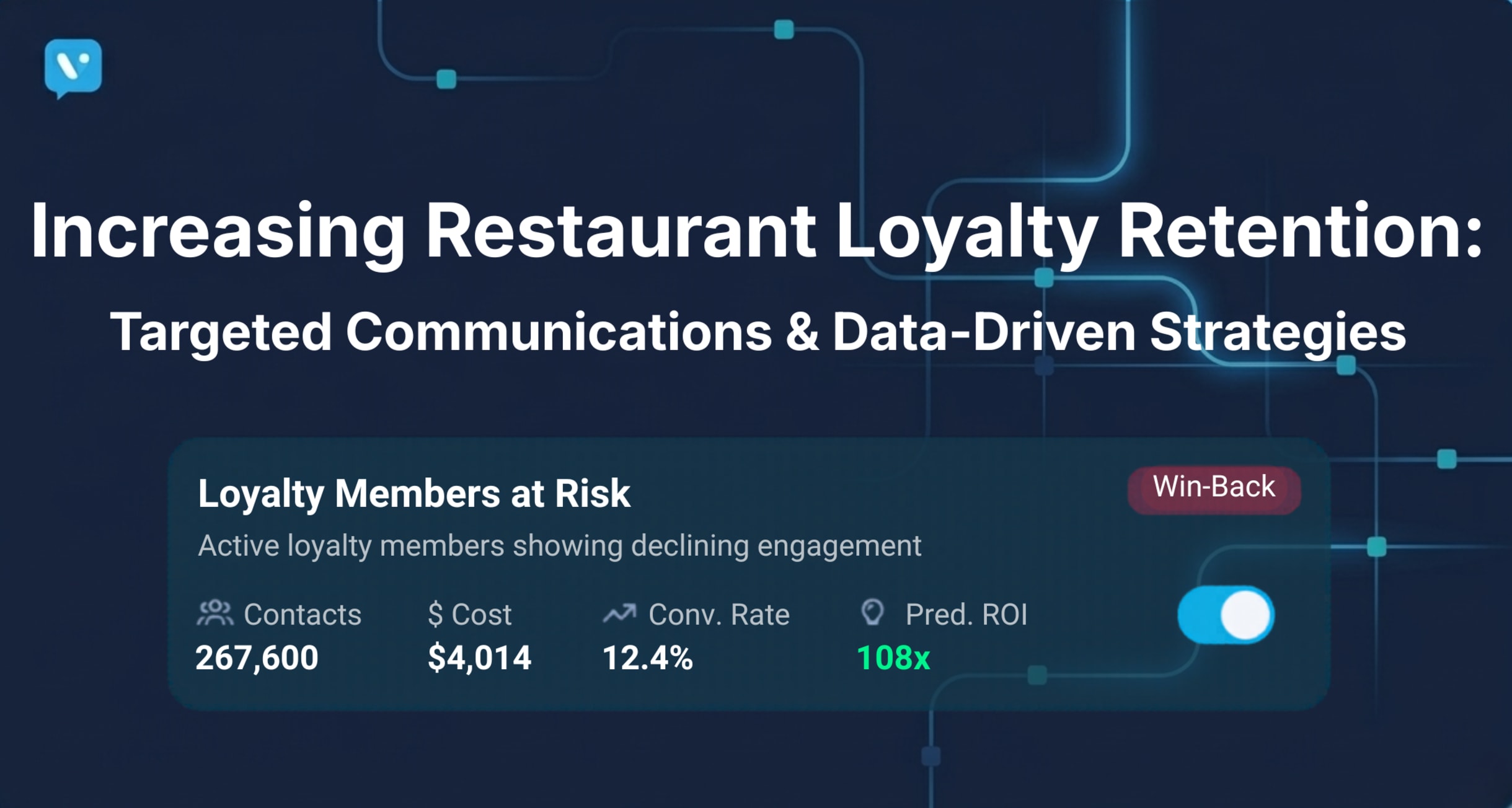
Behavioral data from your POS and loyalty platform is the most reliable early warning system for member churn. The signals worth watching include declining visit frequency, unredeemed points accumulating past a normal threshold and reduced SMS or app engagement.
Re-engagement at this stage has an outsized payoff. Members who actively redeem rewards spend significantly more over time than those who don't, which means pulling even a fraction of lapsed members back into the redemption cycle produces a real lift in lifetime value.
However, identifying at-risk loyalty members and sending them a perfectly timed offer is easier said than done. That is, unless you have the right tools and integrations.
How to Do It: Trigger Automated Win-Back Flows Based on Behavioral Signals
A sophisticated text marketing platform—like Voxie—can integrate with your loyalty and CRM program. Combined, they can detect churn signals for individual accounts and immediately respond with a win-back offer. Reporting will help you not only identify the most effective incentives, but also the optimal timing to re-hook loyal restaurant customers before they fall off entirely.
Different Stage, Different Message: Segmenting by Loyalty Lifecycle
Blasting the same communication to every loyalty member is one of the most common and costly retention mistakes a restaurant can make. Someone who enrolled yesterday needs a fundamentally different message than someone who hasn't visited in 60 days. Treating both identically signals that the program doesn't really know either of them.
The segments that consistently move the needle on restaurant customer loyalty:
- New enrollees (0 to 14 days). Welcome and onboarding sequences that explain how the program works, what to do next, and how to reach that first reward. Getting a member to their first redemption early on matters because it sets the tone for ongoing engagement. If someone never redeems, they're far more likely to go dormant.
- Active, high-frequency members. VIP recognition and early access to new items or promotions that reinforce they're valued, not just another name on a list.
- Members approaching a reward threshold. A nudge to get them over the finish line. "You're 30 points from your next reward" converts far better than a generic promotional blast.
- At-risk members showing early churn signals. Targeted win-back messaging with a tangible incentive, timed to their specific drop-off pattern.
- Fully lapsed members (90+ days inactive). Re-engagement with a direct, immediate offer and a compelling reason to come back.
How to Do It: Dynamically Segment Loyalty Members as Their Behavior Changes
Static lists go stale the moment they're built. A member classified as "active" last week may be "at-risk" today. Voxie's real-time audience segmentation automatically moves members between groups based on live behavioral signals, so every campaign reaches people based on where they are now, not where they were when someone last updated a spreadsheet. The Budget Optimizer then recommends how to allocate spend across these segments for the strongest possible return.

Make Loyalty Texts Feel Personal and Not Like Broadcasts
There's a world of difference between "You have points to redeem!" and "You're 15 points from that free Spicy Chicken Sandwich you love." The first gets ignored. The second drives a visit.
The gap between generic and personalized messaging isn't marginal. Members who receive rewards and offers tailored to their actual behavior spend meaningfully more than those who get the same blast as everyone else.
What this looks like with loyalty data connected to your messaging:
- A points-expiration reminder tied to the member's actual balance: "Hey [first name], you've got 150 points expiring on Friday. That's enough for a free medium drink with your next order!"
- A purchase-based promotion referencing what they actually order: "Your usual Turkey Club is part of this week's BOGO. Swing by before Sunday."
- A milestone celebration that acknowledges their real history with the brand: "12 visits this month. You're officially in our top 10% of loyalty members. To say thank you, we’re giving you a free milkshake on us!”
How to do it: Craft Sophisticated Flows That Pull in Real-Time Customer Data
Each of those texts pulls from a different data source: points balances from the loyalty platform, order history from the POS, and visit frequency from the CRM. Voxie integrates with all three, making it possible to populate individualized fields in each message at franchise scale without manual data work.
Localize Messaging, A Tactic Proven to Lift Engagement by 4X
Franchise restaurants have a natural advantage when it comes to loyalty retention: local presence and community connection. But most squander it by running loyalty communications exclusively at the national level.
Localized messaging consistently outperforms national blasts on engagement, often doubling click-through rates for QSRs and other restaurants.
Localization at scale can feel like walking a tightrope. Franchisees know their local communities better than anyone, but giving them unrestricted messaging access risks brand inconsistency. However, having Corporate manually approve texts slows down progress and simply isn't sustainable.
The solution isn't choosing between national control and local relevance; it’s building a framework that delivers both.
How to Do It: Empower Franchisees to Localize Campaigns While Automatically Enforcing Brand-Shaped Guardrails Using Voxie Intelligence
This is where Voxie's franchise-specific architecture comes in. Corporate teams define the rules once: approved templates, locked or semi-locked snippets, blocked terms, tone guidelines, frequency limits, and scheduling windows. From there, Voxie enforces those rules automatically as franchisees build campaigns.
Franchisees who've earned more trust can draft their own messages, which Voxie's AI-powered Brand Standards vet in real time. If a message uses off-brand language, leaves out a required disclaimer, or pushes outside approved offer boundaries, the system flags or blocks it before anything goes out.
For franchisees still building that trust, Corporate can start them with fully locked templates and gradually expand their creative permissions over time, a progression Voxie calls the "crawl, walk, run" framework.
Meanwhile, Corporate retains full visibility through a centralized dashboard showing every scheduled campaign across every location, with the ability to edit or pull any message before it sends.
The result is localized loyalty messaging that feels community-driven to the customer and brand-safe to the franchisor.

Drill Into Loyalty Data by Location, Not Just the National Average
Treating your loyalty program's performance as a single national number masks the insights that actually drive improvement. A 40% active member rate across 200 locations might mean half your stores are at 60% and the other half are at 20%. Those are two entirely different problems requiring different interventions.
Location-level analysis reveals which markets are retaining loyalty members and which are losing them, which message types resonate in which regions, and where specific franchisees are outperforming or falling behind. Once you can see what the top-performing locations do differently, you can replicate those practices across the system.
This granularity also enables smarter testing. Instead of rolling out a new offer nationally and hoping it works, you can trial it across a subset of locations, measure results at the franchisee level, and scale what performs.
How to do it: Use franchise-level analytics to compare loyalty retention across locations.
Voxie's reporting dashboards mirror franchise hierarchy. Corporate teams get a full roll-up view across all locations with the ability to drill down by franchisee, region, or campaign. Franchisees see only their own data, which makes it practical to run localized tests and measure outcomes before committing to a system-wide rollout.
Let Loyalty Members Tell You What They Want
One of the most underused retention tactics is simply asking members what matters to them. Two-way texting opens a direct channel for short surveys, preference polls, and feedback requests that capture what loyalty members actually care about: favorite menu categories, preferred offer types, ideal messaging frequency, or how they felt about a recent visit.
This is zero-party data, meaning information the member shares voluntarily. Every response strengthens the personalization of future messages, creating a feedback loop where the program feels increasingly relevant over time. It also produces demand signals you can act on immediately, like surveying customers about which new flavor excites them most to guide stocking decisions by location ahead of a launch.
How to do it: Use conversational SMS to collect member preferences and feedback at scale.
Voxie's Conversational Intelligence automates these interactions by detecting intent and sentiment from inbound replies, then routing responses into member profiles to inform future campaign targeting.
What This Looks Like in Practice: A QSR Win-Back Campaign That Turned $1 Into $24
A popular American franchise with over 2,500 locations partnered with Voxie to re-engage 745,000 inactive loyalty members who hadn't made a purchase in over 90 days.
Rather than falling back on the brand's standard double points offer, which customers had grown numb to, the team introduced something more direct: a $3 discount on the next purchase. It was a deliberate shift from long-term incentives to immediate gratification, designed specifically for members who needed a tangible reason to walk back through the door.
Within five days of launch: every dollar spent generated $24 in return (a 2,200% ROI), the campaign achieved a 5.5% click-through rate well above industry averages, and conversion rates jumped 506% compared to previous efforts. The test also validated a broader principle: varied, tangible, limited-time incentives outperform predictable rewards, an insight that now shapes the brand's ongoing retention playbook.
Curious if Your QSR SMS Program is Competitive? Self-Audit Yourself
Most franchise brands know their SMS program could be doing more but can't pinpoint exactly where the gaps are. Voxie's free self-audit covers 28 questions across subscriber growth, engagement strategy, compliance, and reporting infrastructure, all benchmarked against QSR industry standards. In a few minutes, you'll see how your program stacks up and where the biggest opportunities are hiding at the location level. You'll receive an instant score and a personalized action plan so you know exactly where to focus first.
The Building Blocks: Integrations That Make Loyalty Retention Work
Before any of the strategies above can function at scale, the underlying systems in your QSR Business Intelligence and marketing tech stacks need to talk to each other. At minimum, restaurants need their text messaging platform connected to three core systems: the loyalty program, POS, and CRM.
However, these integrations mean nothing if not connected into a text marketing platform equipped to effectively leverage the data.
How Voxie Powers Loyalty Retention for Franchise Restaurants
Generic SMS platforms force franchise brands to work around limitations designed for single-brand operations. Voxie is built from the ground up for multi-location complexity, from role-based permissions and location-level billing to Brand Standards that automate compliance across hundreds of locations. That means less time adapting workarounds and more time executing strategy.
- Built to mirror franchise complexity, not work around it: Billing routes to individual locations. Permissions scale by role, region, or owner group. Reporting follows your franchise hierarchy. The platform reflects how your business actually operates.
- Brand Standards that replace manual approval bottlenecks: Corporate defines the rules once: approved templates, blocked terms, frequency caps, scheduling windows. Voxie's AI enforces them in real time as franchisees build campaigns. No JotForms, no one-day turnaround, no dedicated headcount reviewing every send.
- Franchisee autonomy without franchisee risk: Start locations on locked templates with zero creative freedom. Graduate trusted operators to AI-vetted drafting as they prove themselves. Corporate retains override control on every scheduled campaign across the network.
- Intelligence trained on franchise-specific data: Voxie's predictive engine is built on 1B+ messages across thousands of franchise locations. It optimizes micro-audiences at the individual store level, so a single franchisee with 1,000 subscribers isn't wasting budget blasting all of them with every promotion.
- Works whether franchisees log in or not: Corporate builds automated programs once and they run across every location. Adoption is a bonus, not a requirement. The platform delivers results regardless of how hands-on each operator chooses to be.
- Compliance is managed centrally, not left to individual locations: Opt-out handling, consent tracking, and TCPA safeguards are enforced across every location from one place. No reliance on franchisees getting it right on their own.
Request a demo to see how Voxie helps franchise restaurants retain loyalty members at scale.

About the Author
Ali Spiric
Growth Marketing Manager at Voxie