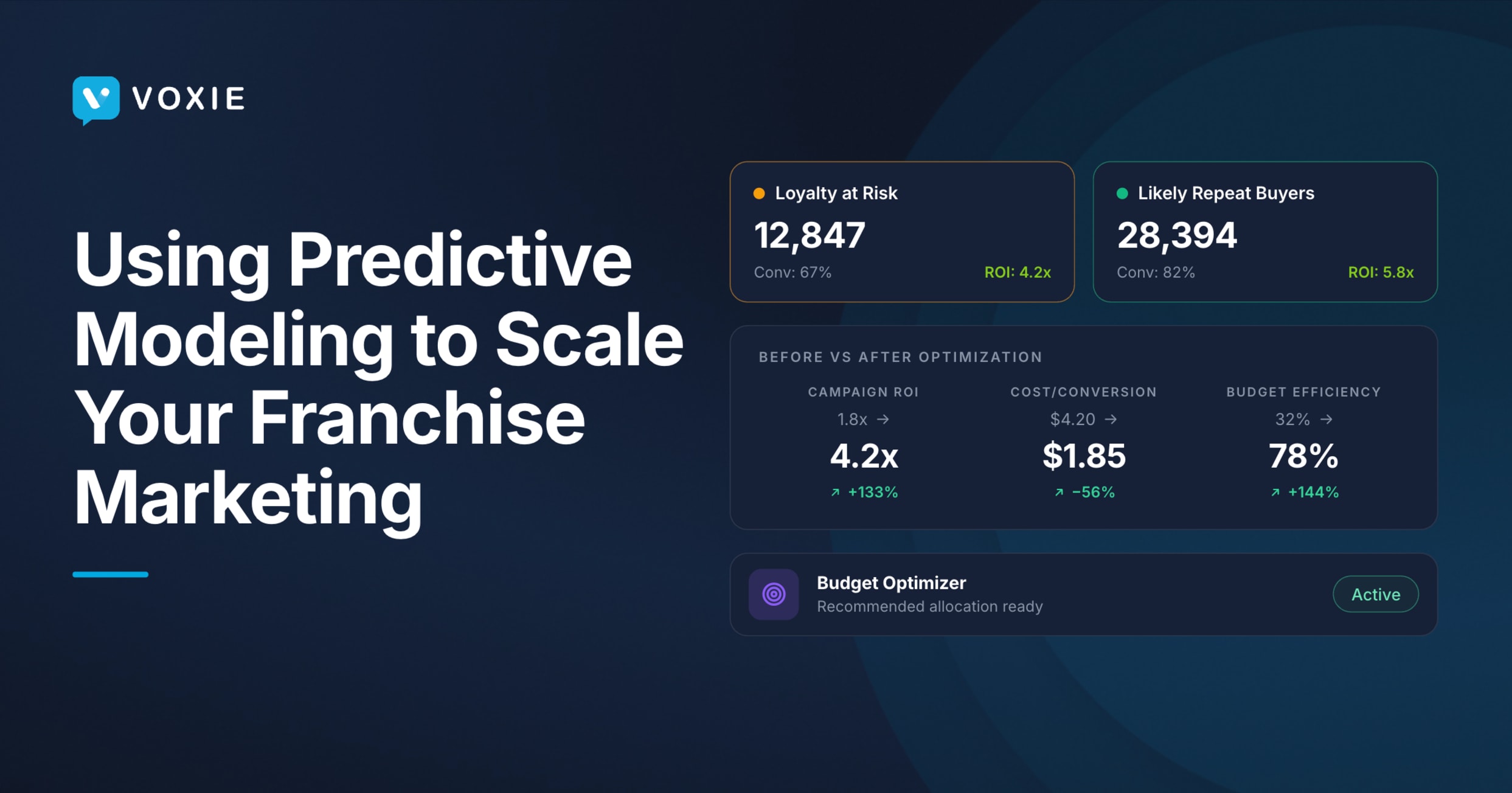
Predictive modeling assigns an expected ROI to every marketing segment, channel, and location before the spend occurs. Thanks to the evolution of AI, such capabilities are now more readily available and already in use by an increasing number of brands. For franchise marketers still operating off retrospective dashboards alone, the cost of not adopting compounds every quarter.
Use Cases for Predictive Modeling in Franchise Marketing
Customer Marketing Budget Allocation
Every franchise marketer faces the same allocation problem: a finite budget and more potential targets than dollars. The default answer has always been spreading budget proportionally across the list or weighting it toward the biggest-revenue segments. Predictive modeling replaces those defaults by assigning a predicted ROI, conversion rate, and cost per conversion to each segment before the spend. In turn, operators can choose specifically which customers to spend more on to maximize returns.
Franchises need systems that interpret campaign performance data both nationally and for location-based subgroups. After all, a high-engagement loyalty member that populates a Downtown Boston storefront may respond differently to a specific LTO than a loyalty member in a suburb of Houston.
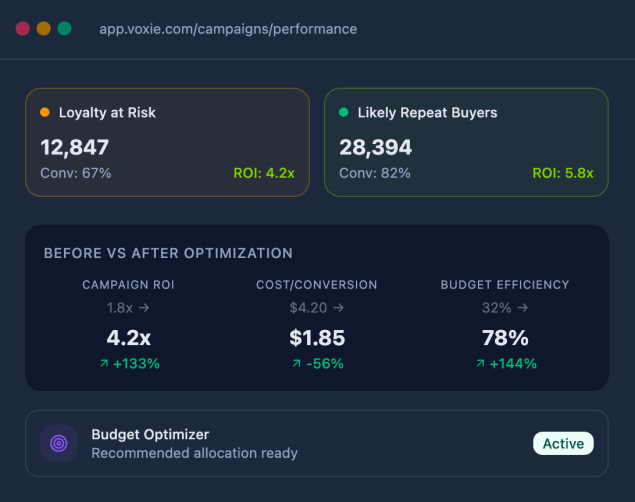
"Talking with our franchise customers revealed the need for a tool that not only predicted campaign ROI but also accounted for the multi-location complexities,” says Tim Hitchner, Voxie VP of Product. “That’s why we developed the Budget Optimizer. Both brands and franchisees can use the tool to effectively segment and target their specific subscribers, rather than making budgeting decisions based on broad, national learnings.” Click here to learn more about the Budget Optimizer from Voxie
Click here to learn more about the Budget Optimizer from Voxie

For an example of predictive modeling in action, look no further than Starbucks’ marketing. Its internal platform predicts for each individual customer which product or offer will convert best given order history, time of day, local weather, and seasonal patterns. The result is a reported 12 to 15% lift in average order value across personalized channels, driven entirely by letting predicted return, rather than a mass campaign calendar, dictate what each customer sees.
Customer Lifetime Value and Churn Prediction
Predictive modeling makes the difference between high-value and low-value customers quantifiable.
CLV models score customers by predicted lifetime value, changing acquisition economics. Instead of weighting acquisition channels by volume, you weight them by the predicted CLV of the customers each channel brings in. A channel delivering 1,000 one-time coupon redeemers looks great on a report but doesn't move the business. The channel delivering 300 high-CLV repeat visitors is where the real money lives, even when the raw numbers look worse at first glance.
Churn prediction runs the same logic in reverse. Behavioral signals like declining visit frequency, unredeemed points accumulating past a normal threshold, and shorter engagement windows feed a model that flags loyalty members before they fully disengage. Win-back offers then land in time to actually win them back, rather than weeks after the customer has already moved to a competitor. Retention costs significantly less than acquisition, and predictive churn signals are what separate retaining a customer cheaply from replacing them expensively.
Uplift Modeling
Uplift models predict who will convert because of marketing, as opposed to who would have converted anyway.
Standard personalization sends offers to the customers most likely to buy, which means a meaningful chunk of that spend lands on people who were already walking through the door. Uplift modeling filters those buyers out and routes marketing dollars only to the customers whose purchase decision actually hinges on the outreach. Most franchise systems are running response models and assuming they're getting uplift. The gap between the two in wasted spend can be significant, and properly-modeled uplift campaigns often lift ROI 30% or more by cutting impressions on already-decided buyers.
Marketing Mix Modeling
The perennial franchise argument: is the national TV buy working, or is the local social spend driving the lift? Marketing mix modeling answers the question at the DMA level by combining econometric modeling for hard-to-track channels like TV, radio, and out-of-home with digital attribution for the trackable ones.
The output isn't a single clean answer, but a clear picture of which channels are actually pulling weight in which markets. For franchise systems, this is where the corporate-versus-franchisee budget debate stops being about opinion and starts being about data. Separate national brand lift from local execution, and most of the political tension in the conversation disappears.
Media Allocation Across Units
Flat allocation and revenue-weighted allocation both leave money on the table. The highest marginal return usually sits with growth-stage units in under-penetrated trade areas, not with saturated top performers. A top-revenue unit in a mature market is often already tapped out, and the extra marketing dollar moves the needle less than the same dollar spent in a developing one. Predictive models surface the difference, and network-level allocation gets routed to units with the highest predicted incremental return instead of the biggest existing top line.
Demand Forecasting
Daypart-level demand forecasting drives staffing and inventory, but it also sharpens local ad timing.
The marketing idea is simple: push promos where the store is predicted to have capacity, and hold back where it's already going to be slammed. Layer in weather, school calendars, and local event feeds, and the forecasts get more accurate. Domino's UK and Ireland reported a 72% improvement in demand forecasting accuracy after implementing ML-based demand planning, which translated directly into fewer wasted promotions at stores that were already running hot.
Barriers to Clear in Order to Setup Predictive Marketing Analytics
Predictive modeling in marketing only works when the foundation underneath it works. Most franchise systems stall out here, not at the model but at the plumbing.
Siloed Data Across the Network
POS, loyalty, digital, SMS, and local marketing data live in different systems that often vary location-to-location. Without a unified data layer, models produce confident-looking nonsense that will get a campaign approved in a budget meeting and quietly fail in the market. Fragmented infrastructure is the hardest and most expensive part of the entire effort to fix, and it's the step franchise systems most consistently under-budget when they start down this path.
To confirm you’ve got an integrated tech stack built for success, read our guides to marketing software for franchises and QSR-friendly tools.
Counting on Generic AI That Doesn’t Factor in Franchise Dynamics or Regional Variation
Off-the-shelf models miss the things that actually matter in a franchise system. They don't distinguish between corporate, co-op, and local spend. They don't understand territory rules, multi-unit data structures, or the corporate-to-franchisee relationship. Worse, most assume a customer is a customer regardless of where they live, which breaks immediately in any multi-unit brand operating across DMAs.
The strategy that wins in Phoenix is not the strategy that wins in Pittsburgh. A generic model trained on aggregate national data flattens those differences and sends the same playbook to both markets, missing the regional signals that actually drive response. Interested in learning more? Check out Voxie’s guide to localized marketing for franchises.
Reporting Dressed Up as Prediction
Half the tools sold into franchise marketing under the predictive label are dashboards with forecasting language bolted on top. If the output is a chart rather than a specific dollar reallocation or a specific action, it's reporting, not predicting. The test for any platform: does it tell you what to do, or does it tell you what happened? A lot of franchise marketing leaders are paying for the second and expecting the first, and the longer that gap goes unnoticed, the more expensive it gets.
No Measurement Discipline
Without control groups, holdouts, and geo-experiments, there's no way to know whether the model is adding value or just adding confidence. Every pilot needs a defined success metric and a way to measure counterfactual performance before it runs. A campaign that lifted sales 12% during the holiday season isn't necessarily a 12% model lift. It might be 2% model lift and 10% seasonal tailwind, and without a control you have no way to tell those two stories apart.
Models that skip this step tend to drift toward numbers that feel great in the quarterly readout and don't survive serious scrutiny.
Treating the Model as the Decision-Maker
The franchise systems that win with predictive modeling treat the model as offense and treat seasoned local operators, brokers, and franchisees as defense. Models have flagged perfect-on-paper opportunities that failed because the prediction missed community culture, competitor loyalty, or local context that a franchisee would have caught in five minutes. The model informs the call, but it shouldn't be the one making it.
Get to Know Voxie and the Budget Optimizer
Voxie is the SMS marketing platform built specifically for franchises, and the Budget Optimizer is how we put predictive modeling in marketing directly in the hands of franchise marketers without requiring a data science team to build it from scratch.
You tell the Optimizer your SMS budget. It analyzes your subscriber base in real time, surfaces the highest-value (or vicarious) segments, attaches a predicted ROI and cost per conversion to each, and recommends how to allocate the budget across those segments. These segments update automatically as customer behavior shifts, so campaigns always target people based on where they are now, not where they were when a list was last pulled.
The predictions aren't generic. Voxie Intelligence is trained on more than 1 billion franchise customer messages, which means the segmentation logic already understands multi-unit dynamics, regional audience behavior, and the differences between corporate and local execution. That context is why brands using the Budget Optimizer consistently report campaign ROI moving from 1.8x to 4.2x, cost per conversion dropping from $4.20 to $1.85, and budget efficiency climbing from 32% to 78%.

About the Author
Ali Spiric
Growth Marketing Manager at Voxie
Ali Spiric is the Growth Marketing Manager at Voxie, an SMS marketing platform built for franchise and multi-location brands. Her work puts her in daily contact with the campaign data, customer results, and messaging trends shaping how franchises use text. She has 7+ years of marketing experience focused on measurement and revenue attribution, and her writing has been cited in Forbes.