Franchise marketing comes with decisions most businesses never face: who owns each campaign, how much a location can customize, and how the brand stays consistent as the network grows. The right software settles many of those questions before they become problems.
Franchise marketing software, sometimes called a franchise marketing platform, system, or solution, lets a brand team build approved campaigns and assets once. Each location can then localize and launch them. We’ve grouped the platforms below by marketing function, and each one includes features built for multi-location networks.
Most brands won’t need every category. Start with the channels your local franchise marketing strategy depends on most.
Franchise Marketing Software Overview
| Tool | Function | What makes it franchise-friendly | Best for |
|---|---|---|---|
| Easil | Graphic design | Branded franchisee portals with locked templates | Brands that also produce print and apparel |
| Canva | Graphic design | Brand Kit and locked template elements | Networks that want a design tool with a short learning curve |
| Sendible | Social media scheduling | Approval workflows and shared calendars | Brands that review franchisee posts before they go live |
| Voxie | SMS marketing | Franchise Hub with role-based access | Franchise brands running national and local texts |
| Mailjet | Email marketing | Location subaccounts under one master account | Networks of up to 20 locations, or larger ones on a custom plan |
| The Mailworks | Direct mail | Brand-approved templates and coordinated mail dates | Franchisors who’d rather outsource direct mail |
| Brandfolder | Digital asset management | One library of approved assets for every location | Brands with large, frequently updated asset libraries |
| RetailNext | In-store analytics | Foot traffic and conversion data compared across stores | Retail and restaurant brands studying in-store behavior |
| TapMango | Loyalty programs | One customer database shared across locations | Restaurants and retailers with in-store loyalty programs |
| BrightLocal | Local SEO and listings | Per-location rank tracking with roll-up reports | Tracking local search rankings for each location |
| Chatmeter | Review management | Review and sentiment insights across locations | Brands combining reviews, listings, and surveys in one tool |
| Tiger Pistol | AI-powered local advertising | Brand-approved ad templates for franchisees | Franchisees with little experience buying ads |
| Marvia | AI content tools | Brand-voice captions and auto-tagging, with brand approval | Brand teams producing local content in several languages |
Each of these franchise-friendly tools were chosen based on information available on October, 2026.
What to Look for in Franchise Marketing Software
The franchise marketing solutions on this list share features that make them practical for multi-location networks. Use these criteria to evaluate any franchise marketing platform you’re considering.
- Parent and child accounts: Brand teams see every location’s activity. Each location sees only its own.
- Role-based permissions: Brand, regional, and franchisee users get different levels of access.
- Locked brand templates: Franchisees edit approved fields like address, offers, and photos. Logos, fonts, and colors stay fixed.
- Approval workflows: Brand teams review local content before it goes live.
- Reporting that rolls up: Results appear per location and across the system, so brand teams can compare markets.
- Budget and ad fund tracking: Some platforms separate spend from the brand fund and the franchisee. This matters most for advertising and print.
- POS, CRM, and loyalty integrations: Customer data moves between systems without manual exports.
- Vendor-led onboarding: Franchisees have mixed technical skill, so setup help and training matter.
Graphic Design Software for Franchise Marketing: Easil and Canva
Why We Chose Easil
Easil is a drag-and-drop design platform with an enterprise tier built around franchise portals. Each portal carries the brand’s colors, imagery, and logo. Brand teams build editable templates, lock the elements that can’t change, and require approval before certain designs go out.
Franchisees save time with Smart Text, which auto-fills text they use often. Brand teams can track logins, popular templates, downloads, and marketing fund credit allocation. Easil also handles print and apparel production, which helps brands that still rely on flyers, signage, and uniforms.
Why We Chose Canva
Canva is a widely used design platform with a large template library and a short learning curve. Franchisees and their staff can make polished graphics without design training.
Its franchise features let brand teams build templates and lock the elements that can’t change. A Brand Kit keeps colors, fonts, and logos consistent across projects. Teams can also add approval steps, collaborate on designs, and plan posts on shared social calendars.
That mix gives franchisees room to make their own social graphics. Locked elements and shared calendars keep every location on-brand and coordinated.
General Tips for Using Graphic Design Software for Your Franchise
Strong local social content blends national messaging with regional references. Choose a design platform that gives franchisees the right amount of creative freedom for your brand.
Decide whether franchisees will build posts from scratch or fill in existing templates. Either way, load brand colors and fonts into the platform so every design starts on-brand.
Pick a platform that doesn’t require design experience. Franchisees and their teams will have mixed skill levels.
Social Media Scheduling Software for Franchise Marketing: Sendible
Why We Chose Sendible
Sendible is an all-in-one social management platform with features that include scheduling, content management, and analytics. Importantly, this platform caters to franchise and multi-location business models with capabilities like centralized calendars, shared inboxes, formalized content approval workflows, bulk campaign uploads, and customizable access levels.
RE/MAX Realtron uses Sendible to manage social media for 1,200 agents.
One long-time customer on Trustpilot uses Sendible to “publish content for a nationwide franchise with nearly 300 branches.”
General Tips for Using Social Scheduling Software for Your Franchise
Choose a platform with flexible analytics views at the brand level and for each region or location. Location-level data shows which audiences respond to which content.
If franchisees manage their own accounts, the brand team should be able to see and approve scheduled posts. In-platform messaging between brand and franchisee teams speeds up feedback.
Consolidated inboxes help too. They let the brand team see customer conversations across locations and step in when needed.
SMS Marketing Platform for Franchises: Voxie
Why Voxie Is on This List
Voxie is an SMS marketing platform built specifically for franchise and multi-location brands. The Franchise Hub lets brand teams set network-wide campaigns and guardrails. Each location still runs local texts and one-to-one conversations.
Key capabilities include:
- AI Blast Vetting reviews local drafts before sending
- Brand Standards set frequency caps, sending hours, content rules
- Locked Snippets keep approved wording intact
- Reserved Dates protect national promotion windows
- Blast Calendar shows every scheduled local send
- One opt-out honored across every location
- Role-based access for brand and franchisee users
- Two-way texting with handoff to local staff
- Dedicated Customer Success Manager support
See the full list of Voxie’s franchise SMS features.
More than 20,000 franchise locations text through Voxie. Nineteen of the brands behind them made Entrepreneur’s 2026 Franchise 500, and Entrepreneur ranked Voxie among its Top Franchise Suppliers for 2026.
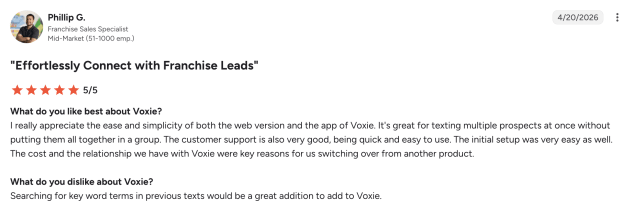
Phillip G., a franchise sales specialist, switched his team to Voxie from another texting product. In his G2 review, he credits the cost and his relationship with the Voxie team for the move.

General Tips for Using SMS Marketing Software for Your Franchise
Segment audiences by region, purchase history, and engagement level. After all, personalized messages earn more replies and build stronger local connections.
Review your data regularly, looking for the times of day that drive the most engagement and the regions that respond best to certain promotions. Use those findings to shape your next round of tests.
Lastly, a shared text message marketing playbook keeps every location aligned on timing, tone, and compliance. Pair it with a bank of proven campaign ideas franchisees can adapt.
Email Marketing Software for Franchises: Mailjet
Why We Chose Mailjet
Mailjet is an email marketing platform with features suited to franchise networks. A master account holds separate subaccounts for each location, and Brand Kit keeps templates consistent. User permissions limit what each team member can edit.
The collaborative drag-and-drop editor supports multiple languages and is simple enough for a store manager to use.
Plan for growth before you sign up. Premium plans allow up to 20 subaccounts, so larger networks need a custom plan.
General Tips for Using Email Marketing Software for Your Franchise
Customer segmentation and automated list management matter most for franchise email. They let brand teams target audiences by location, purchase behavior, and engagement.
For the best return, align email with SMS, social media, and in-store promotions. Customers should see one consistent message across every touchpoint.
Direct Mail Services for Franchise Marketing: The Mailworks
Many of the same principles that apply to SMS or email marketing for franchises also apply to direct mail: different localities may benefit from different messaging or offers. What’s more, disjointed campaign management can lead to sloppy execution and thin data analysis.
Why We Chose The Mailworks
The Mailworks is a full-service direct mail provider with a program built for franchises. Its team handles list management, creative, printing, and mailing in-house. That suits franchisors who’d rather outsource direct mail than run it themselves.
Franchisees order campaigns from brand-approved templates and customize them by market, offer, or timing. Mail reaches homes for every location within a three-day window, and delivery tracking shows when each location’s mail lands. Franchisors can join a Partner Program that covers creative, list management, production, and reporting for the whole network.
Youth Athletes United, the youth sports franchisor behind Soccer Stars and Amazing Athletes, uses The Mailworks to reach families in each franchisee’s territory. Campaigns pair targeted mailing lists with QR codes that lead families to registration pages. Super Soccer Stars’ CMO says enrollment has gone up at every location where they’ve run campaigns with The Mailworks.
General Tips for Using Direct Mail for Your Franchise
Tracking conversions remains a challenge across many marketing channels, including direct mail. Several tactics can help tie outreach to conversions, such as including an immediate call to action with a QR code, using trackable URLs or phone numbers, or providing campaign-specific coupon codes.
Integrate your direct mail data with your CRM. This will reveal whether certain franchisees’ mailing lists respond more effectively to direct mail than others.
Digital Asset Management Software for Franchises: Brandfolder
Why We Chose Brandfolder
Brandfolder gives every location one library of approved marketing assets. Franchisees pull current logos, photos, and campaign files themselves, which cuts down on requests to the brand team.
Content Automation templates live inside Brandfolder, where users can customize them and export finished assets. Multi-page templates cover print pieces like brochures and catalogs. Content reporting and automatic expiration dates help retire outdated assets before they reach customers.
A brand manager at Hard Exercise Works, a fitness franchise with 20 locations, said on Capterra that it’s “a huge help to have this software in our arsenal of technology.”
General Tips for Using Digital Asset Management Software for Your Franchise
A digital asset library is only useful if it holds every current asset. Make it the single source for campaign files from day one.
Look for AI-powered tagging and search. Franchisees should find what they need in seconds.
In-Store Analytics Software for Franchise Marketing: RetailNext
Why We Chose RetailNext
RetailNext grants high-level visibility into in-store interactions beyond mere transactions. It captures foot traffic, conversion rates, and shopper journeys, including movement, dwell times, and how store layouts and product placements perform.
By understanding these dynamics, franchises can optimize layouts, enhance customer experiences, and ultimately drive higher sales. The platform’s ability to analyze patterns over time also allows for more informed decision-making. For example, if you want to boost your franchise’s loyalty program, you can use RetailNext insights to decide where to place signs and QR codes throughout your locations.
For restaurant franchises, RetailNext also offers guest traffic forecasting and labor scheduling.
General Tips for Using In-Store Analytics Platforms for Your Franchise
Choose in-store analytics platforms that can consolidate data across multiple locations for a comprehensive view. Additionally, ensure the platform complies with GDPR and CCPA to protect customer privacy while gathering valuable insights.
Loyalty Program Software for Franchises: TapMango
Why We Chose TapMango
TapMango is a loyalty platform for multi-location restaurants and retailers. Locations share one customer database, which gives the brand a single view of each member’s activity. That view helps connect in-store purchases to the campaigns that drove them.
Customers can join through an in-store tablet, onsite enrollment, or a branded app. Digital punch cards, promo codes, referrals, and online ordering round out the program.
One franchise owner on Capterra wrote, “I have recommended [TapMango] to many of my fellow franchisees.” The reviewer added TapMango right after buying a second franchise location.
General Tips for Using Loyalty Program Software for Your Franchise
Promote the program both online and in-store so the experience feels unified. Prompt every in-store customer for their loyalty details, which ties each purchase to a campaign.
QR codes at the counter and on packaging make sign-ups easy. Give each location its own code so you can compare enrollment by store.
Integrate the loyalty program with your CRM and POS. Shared data keeps customer profiles accurate across systems.
Local SEO, Listings, and Review Management Software for Franchises: BrightLocal and Chatmeter
Why We Chose BrightLocal
BrightLocal automates citation building and tracks local rankings for each location. Multi-location brands get location-level reports and an aggregated roll-up across the network. A newer feature shows how a business appears in ChatGPT and Google’s AI results.
Why We Chose Chatmeter
Chatmeter, now part of Alchemer, is a reputation management and brand intelligence platform for multi-location brands. It combines review management, listings across more than 140 online directories, social media management, and customer surveys.
AI-powered sentiment analysis pulls recurring themes from customer reviews. Teams can reply using generative AI, suggested response templates, or custom responses. A&W makes Chatmeter participation part of the scorecard franchisees must meet before opening a new location.
General Tips for Using Local SEO and Listing Management Software for Your Franchise
Local SEO still needs hands-on attention, even with automated citations and listings. Google Business Profile deserves the most care of any listing.
Give each location page unique content, such as local staff, services, and community details. For the strongest results, consider a local SEO specialist.
Treat AI search visibility as an extension of local SEO. AI tools draw on accurate listings, consistent reviews, and detailed location pages, and BrightLocal now reports how locations appear in AI results.
AI Software for Franchise Marketing: Tiger Pistol and Marvia
AI helps franchise marketers most in two places: building local ads and producing local content faster. These two platforms cover each one.
Why We Chose Tiger Pistol
Tiger Pistol is an AI-powered local advertising platform for franchise and multi-location brands. Franchisees launch brand-approved ads on Facebook, Instagram, TikTok, Google, and Amazon from templates the brand team sets up.
Bulk local publishing adds location-specific creative to each ad, and AI optimizes budgets. That matters for franchisees who’ve never bought media. Brands can work with franchisees directly or through regional agencies. Wendy’s and Great Clips both use it for franchisee advertising.
Why We Chose Marvia
Marvia is a local marketing platform built for franchise and multi-location brands, including Domino’s, KFC, Burger King, and KidStrong. Its AI features help brand teams and franchisees produce local content faster.
Images are tagged automatically when they’re uploaded. Social captions are written in the brand’s tone of voice, and content translates into other languages instantly. Brand teams review and approve AI-generated content before it goes live.
Marvia doesn’t use customer content to train AI models, and all AI processing runs in an isolated environment.
A G2 reviewer at a franchise brand said that “our franchisees are very committed and involved in their local marketing activities.”
General Tips for Using AI Software for Your Franchise
📖
Set the guardrails before franchisees start. Decide which offers they can promote, what the brand voice sounds like, and how much each location can spend. AI tools follow the rules you give them, and vague rules lead to off-brand ads and captions.
📈
The quality of AI output depends on what you feed it. Strong brand guidelines, approved photos, and examples of past posts that performed well all lead to better captions and ads. Keep your asset library organized so the AI pulls from current, approved images.
👥
Pay attention to how franchisees use the tools. Some will publish every AI suggestion as-is, and others won't use the features at all. A short training on when to edit, approve, or skip AI output keeps quality consistent across the network.
Start Building Your Franchise Marketing Tech Stack With Voxie
Most franchise marketing stacks combine several of the categories above. Text messaging belongs near the center. SMS has a 98% open rate, and it supports both national promotions and one-to-one local conversations.
Voxie's platform is built for franchise and multi-location brands. It gives brand teams network-level guardrails and leaves room for each location to localize. Request a demo to see how it fits your stack.
Franchise Marketing Software FAQs
What is franchise marketing software?
Franchise marketing software is any marketing tool built for a network of locations operating under one brand. The brand team creates approved campaigns, templates, and assets. Each franchisee adapts them for its own market, and reporting shows results by location and across the network.
How is a franchise marketing platform different from standard marketing software?
A franchise marketing platform adds a layer for the brand team that standard tools usually lack. That layer includes parent and child accounts, role-based permissions, locked templates, and approval steps. Brand teams see the whole network, and each franchisee sees only its own location.
How do you choose a franchise marketing platform?
Start with the channels your local marketing depends on most, such as text, email, or social. Then check each option against the criteria above, especially permissions, locked templates, and roll-up reporting. Ask how the vendor onboards franchisees, since setup support often decides whether locations use the tool at all.

About the Author
Ali Spiric
Growth Marketing Manager at Voxie
Ali Spiric is the Growth Marketing Manager at Voxie, an SMS marketing platform built for franchise and multi-location brands. Her work puts her in daily contact with the campaign data, customer results, and messaging trends shaping how franchises use text. She has 7+ years of marketing experience focused on measurement and revenue attribution, and her writing has been cited in Forbes.