Technology plays a role in nearly every part of running a QSR, from sales and operations to marketing and logistics. Across the latest industry data and brand announcements, the most important QSR technology trends share a common theme: QSRs are using technology and AI to personalize each guest’s experience more than ever before.
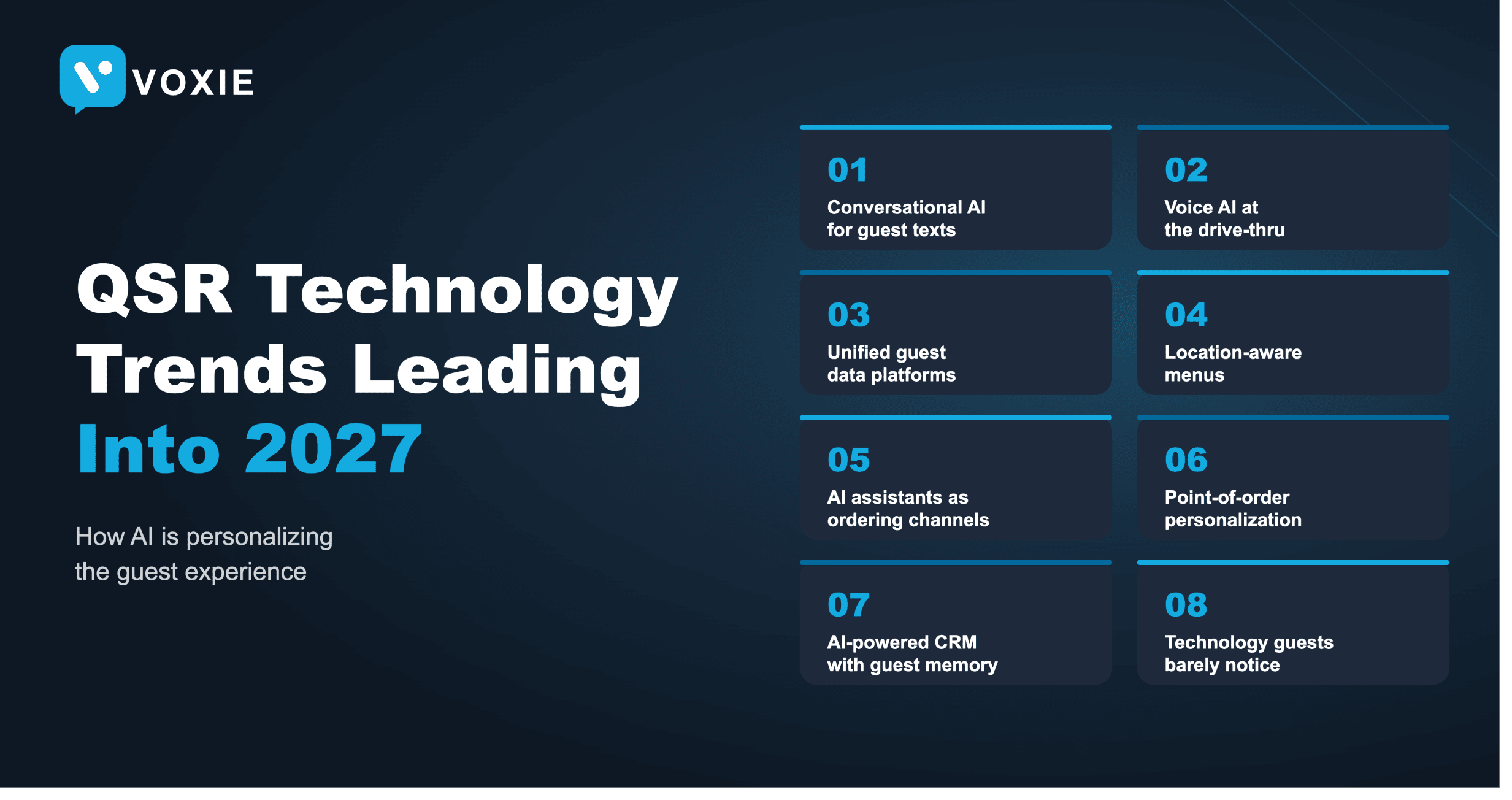
- Conversational AI is changing who answers QSR guest texts
- Voice AI is maturing at the drive-thru
- Unified data platforms are connecting every QSR ordering channel
- Location-aware systems are keeping menus accurate store by store
- AI assistants are becoming an ordering channel
- Point-of-order personalization is proving its value
- AI-powered CRM is giving QSR marketing a memory
- The best QSR technology feels invisible to guests
Conversational AI Is Changing Who Answers QSR Guest Texts
For many restaurants, conversational AI now handles the first response when a guest sends a text. These tools can sort incoming messages, draft replies, and answer routine questions without pulling staff away from the line.
The most advanced tools also look past the literal wording of a message. Voxie Intelligence is one example of what’s possible, giving brands a read on both the intent and the emotion behind each text. That deeper understanding helps restaurants recognize when a conversation needs a person, answer questions more accurately, and make sense of open-ended survey responses that don’t fit a multiple-choice format.
The biggest benefit is triage, since guests text restaurants about very different things:
- Routine questions. Holiday hours, pickup windows, and order status deserve instant answers, which AI can provide around the clock.
- Menu questions. AI can usually handle these on its own.
- Catering inquiries. A 40-person order for Friday is one of the most valuable messages a store will receive. It needs to reach staff quickly, ideally while the guest is still comparing options.
- Feedback. Replies to a post-visit text can surface a problem before it turns into a public review.
- Complaints. These belong with a person at that location.
Even the best conversational AI needs a clear path to a person. A guest with a simple question appreciates an instant answer, while a guest with a problem wants to know someone at the store is paying attention. In our view, the handoff will separate good conversational AI from frustrating conversational AI in 2027. Brands should decide in advance which messages AI can resolve and which go straight to staff.
Voice AI Is Maturing at the Drive-Thru
Among this year’s QSR AI trends, few are moving faster than voice ordering at the drive-thru. Taco Bell has rolled voice AI out to nearly 900 U.S. restaurants, and other major chains are expanding their own programs.
The technology is also getting noticeably better. In QSR Magazine’s 2026 Drive-Thru Report, the share of AI interactions that handled a guest’s entire order doubled from the previous year. Voice AI is moving well beyond the automated greetings of its early pilots.
We expect customization to define the next stage. Simple orders are largely solved. Orders with several changes, such as removing an ingredient, adding a sauce, and swapping a side, are where today’s systems most often hand off to a team member. Systems that handle those requests smoothly will deliver a more personal experience than a rushed team member at peak hour can.
The drive-thru window still matters, too. When AI takes the order, the handoff at the window becomes the main human moment of the visit.
Unified Data Platforms Are Connecting Every QSR Ordering Channel
As ordering channels multiply, more QSR brands are turning to unified data platforms to see each guest in one place. Older tech stacks often stored app, kiosk, drive-thru, and loyalty data separately, so a regular who used all four could look like four different people.
Nearly every other QSR technology trend on this list depends on unified data. Personalized offers, accurate loyalty recognition, and well-timed messages all require a system that knows who the guest is.
The largest chains are building that foundation themselves. McDonald’s rearchitected its digital foundation to unify ordering, marketing, loyalty, and data. Yum Brands built Byte, and Taco Bell’s digital growth is now coming mostly from first-party loyalty channels.
Most QSR brands won’t build a platform of their own. For them, integration should be a deciding factor in every technology purchase.
Location-Aware Systems Are Keeping Menus Accurate Store by Store
Some of the most practical QSR technology focuses on the restaurant itself, keeping every channel accurate to what each location can serve. Burger King’s AI assistant, Patty, can remove items from digital menus and the app when a restaurant runs out.
Personalization only helps when the offer matches what the store can serve. A targeted offer for an item the nearest location just sold out of frustrates the guest it was meant to win over.
AI Assistants Are Becoming an Ordering Channel
One of the newest QSR AI trends is assistants placing orders on a guest’s behalf. Square added ordering integrations with ChatGPT and Claude in 2026, sending orders straight to each restaurant’s POS.
It’s too early to know how many guests will order this way. Delivery marketplaces offer a useful comparison. They brought convenience and new customers, and they also came between brands and the guests they served. AI assistants could follow a similar path, since each order teaches the assistant more about the guest’s habits.
Brands don’t need to rush into this channel. They should, however, keep strengthening the channels they own, such as their apps, loyalty programs, and text lists.
Point-of-Order Personalization Is Proving Its Value
For brands weighing where personalization pays off, the drive-thru offers some of the clearest evidence. The same 2026 Drive-Thru Report found satisfaction rose noticeably when guests were greeted by name or recognized as loyalty members, yet only about one visit in eight included any personalization at all.
Those gestures are simple, and most visits still miss them. Busy teams can’t remember every regular, and many systems don’t tell them who’s at the speaker. Several technologies are making those small gestures repeatable:
- Loyalty recognition at the point of order. Identifying members at the speaker or kiosk lets teams greet guests by name, mention their rewards, and turn a routine stop into a visit that feels personal.
- Adaptive digital menu boards. These can feature a guest’s favorite items.
- Geofenced mobile ordering. Starting an order as the guest pulls in means the food is ready when they arrive.
AI-Powered CRM Is Giving QSR Marketing a Memory
AI-powered CRM is helping restaurants remember each guest’s history and tailor offers to it. The National Restaurant Association points to these platforms as the way operators are moving beyond blanket discounts toward individualized offers.
A guest’s history should shape every message they receive. A guest who only visits for breakfast should hear about the new breakfast sandwich. A regular whose visits slow from weekly to monthly needs a different message than a first-time guest who never came back.
Restaurants should be thoughtful about how they use that history. Guests expect a brand to know what they order and how often they visit. Offers that reflect that history feel helpful, while anything beyond it can start to feel intrusive.
The Best QSR Technology Feels Invisible to Guests
Guests and operators don’t always see restaurant technology the same way. According to the National Restaurant Association’s 2026 State of the Industry report, nearly two-thirds of operators believe technology improves hospitality, while only 41% of consumers agree.
That gap doesn’t mean guests dislike technology. Most are happy to order from a kiosk or pay on their phone because it saves them time. What guests resist is technology that slows them down, calls attention to itself, or seems to stand between them and a person.
Every QSR technology trend above depends on how a brand introduces it. The rollout largely decides which side of that line a new tool lands on.
Rollouts That Tend to Succeed
- Pilot in your hardest stores, too. A pilot limited to well-run, moderate-volume locations will make almost any tool look good. Include a high-volume drive-thru, a store with high turnover, and one with a regional menu. Set the criteria for expanding, such as accuracy, speed, and guest satisfaction, before the pilot begins, so results can’t be reinterpreted afterward.
- Train for the moments the technology fails. Teams pick up normal operations quickly. What they need is a plan for when voice AI misunderstands an order or a kiosk goes down mid-rush. Give every shift a clear override process and one person who owns troubleshooting.
- Explain what the tool takes off each person’s plate. Teams adopt technology faster when they see it removing a task they dislike, like repeating orders through a headset or manually updating sold-out items. That explanation also answers the question many team members won’t ask out loud, which is whether the tool is there to replace them.
- Map the data before launch. Decide what the new tool needs from the POS, loyalty program, and marketing systems, and what it sends back. A tool that runs on its own screen adds a step for staff and creates another silo of guest data.
- Design the human handoff deliberately. Define exactly when AI should pass a guest to a person, such as a complicated customization, a complaint, or a second misunderstanding. The handoff should carry context with it, so the guest never has to repeat themselves.
- Share results with operators store by store. Owners and managers trust their own numbers far more than a system-wide average. Showing each location how the tool performed there builds buy-in faster than any announcement.
Rollouts That Tend to Backfire
- Launching everywhere at once. Problems surface in every store simultaneously, and there’s no comparison group left to show whether the tool helped. A phased rollout also lets each new wave of stores benefit from what earlier stores learned.
- Using AI only as a greeter. An automated hello that hands guests to a team member seconds later adds a step without saving any time. Guests notice the extra friction, and the brand gets little of the benefit.
- Judging success on labor savings alone. A tool can cut labor hours while quietly lowering accuracy, satisfaction, or the warmth guests expect at the window. Tracking guest-facing measures alongside cost keeps those tradeoffs visible.
- Advertising the technology itself. Positioning AI as the headline invites guests to scrutinize every mistake. Taco Bell learned this when clips of its AI ordering errors went viral, including one guest’s order for 18,000 water cups.
- Treating launch as the finish line. Menus, limited-time offers, and inventory change constantly. AI tools need regular tuning to keep up, or their accuracy slips with every menu update.
Individualized Text Messaging for QSRs With Voxie
Text messaging is one of the most direct ways to extend these QSR technology trends beyond the restaurant. A well-timed text can recognize the guest, reflect what their nearest store is offering, and build on their last visit. Voxie gives QSR brands the tools to send individualized texts across every location while keeping brand standards consistent.
- Intelligent Inbox ranks conversations by revenue potential
- AI reply suggestions follow brand guidelines
- Brand Standards flags off-brand messages and prevents sending
- Brand programs send from local numbers
- Integrations connect CRM, POS, and loyalty data
- At-risk loyalty members flagged for win-back
- SMS, MMS, and RCS in one platform
Sonic Drive-In offers a good example of what connected data can do for a QSR. By syncing texting with its CRM, Sonic automatically texted incentives at early signs of churn and tripled its LTO redemption rates.
Book a demo to see how Voxie supports individualized text messaging across your restaurants.

About the Author
Ali Spiric
Growth Marketing Manager at Voxie
Ali Spiric is the Growth Marketing Manager at Voxie, an SMS marketing platform built for franchise and multi-location brands. Her work puts her in daily contact with the campaign data, customer results, and messaging trends shaping how franchises use text. She has 7+ years of marketing experience focused on measurement and revenue attribution, and her writing has been cited in Forbes.