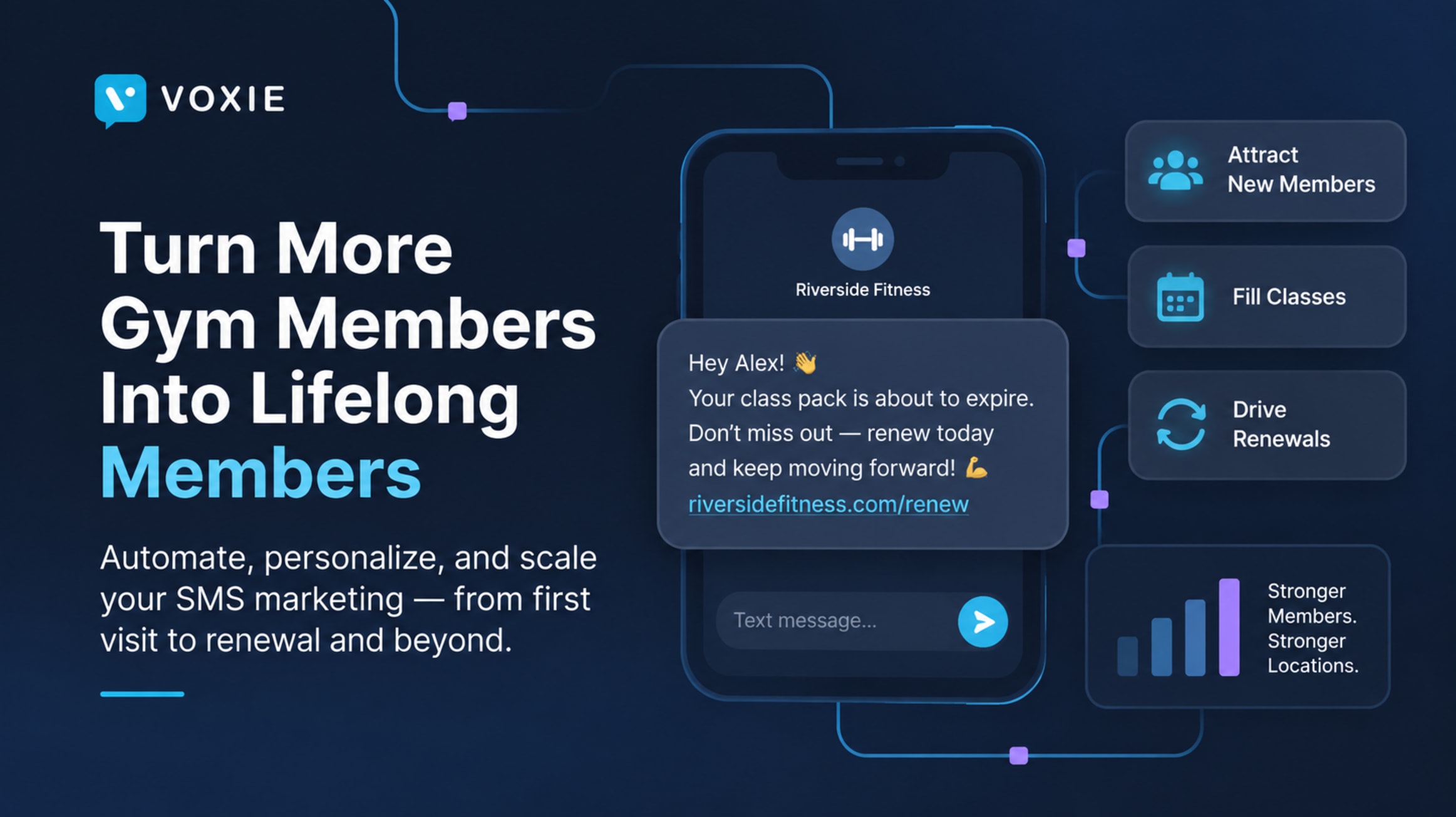
You probably already know the basics of text marketing for fitness centers: Keep it short. Say who it is from. Give the member a reason to care along with an obvious next step. If you want to go deeper on message craft, Voxie's guides to high-converting texts, MMS, and SMS campaign examples cover it.
Simple text messaging principles are enough when marketing a single gym. They fall short once a fitness brand spans dozens, let alone hundreds, of locations. The challenge becomes getting strong execution across the network, especially at the locations least likely to build a strong SMS program on their own.
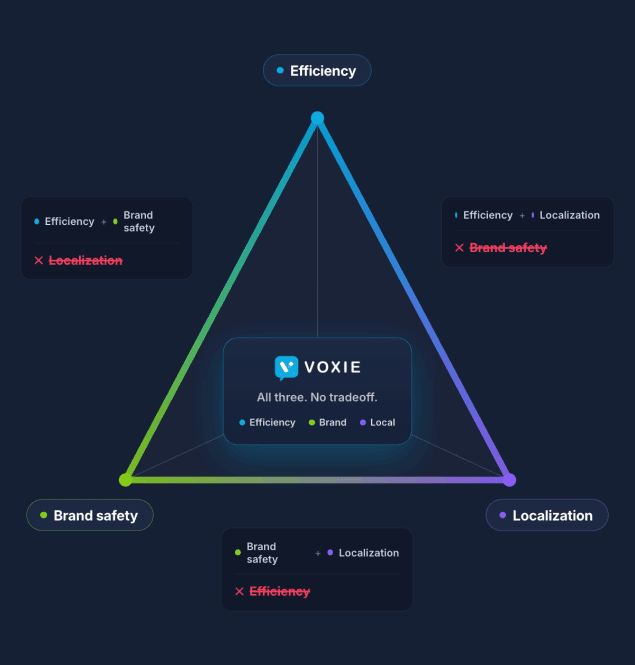
System-Wide Consistency AND Localization: Have Your Cake and Eat It Too
Some franchisees are more proactive than others. One gym may send weekly SMS campaigns and follow up on inquiries in minutes. Another may default to radio silence.
That individuality shows up in the campaigns and conversations, too. Local flavor is one of the strengths of a franchise model, but it carries risk. One location may barely text while another sends too often, drifts from the brand voice, or reaches the wrong audience.
The goals of any fitness franchise SMS program should be to efficiently:
Close the engagement gap between top and bottom-performing locations
Protect brand standards without stifling franchisee creativity
Nurture localization through both national and individual franchisee efforts
Close the Engagement Gap Between Top and Bottom-Performing Gym Locations
The strongest locations may already have good follow-up habits. The program needs enough intelligence and automation to bring the rest of the network closer to that standard.
- Connect behavioral data to messaging triggers. Sync SMS with the CRM, booking, scheduling, and enrollment systems that already show what members are doing. A trial lead who never books or a regular whose attendance drops can enter the appropriate follow-up flow automatically.
- Don't fly blind; flag low-engagement locations. Corporate needs a clear view of which gyms barely send, where leads routinely sit unanswered, and where member conversations fall off. Location-level engagement and response data expose those gaps before weak execution becomes a larger retention or revenue problem.
- Use Voxie's Intelligent Inbox to highlight high-value conversations. Enrollment-ready leads and gym tour requests should rise above schedule changes and routine questions. Better still, tools like Voxie can identify tone with 98% accuracy, further indicating which SMS conversations should be deemed high priority. All this can lead to franchisees' SMS inboxes automatically sorting the most urgent and lucrative conversations toward the top instead of relying on chronological order.
- Turn top-location behavior into a network-wide SMS playbook. Compare response times, engagement patterns, and conversion by location to see what stronger gyms consistently do differently. Those patterns can inform coaching, automations, and campaign defaults across lower-performing locations.
Protect Brand Standards Without Stifling Franchisee Creativity
Franchisees need enough room to act on what they see locally. The Saturday morning crowd may be mostly parents, a popular instructor may have just added a class, or a nearby 5K may suddenly make cross-training relevant.
Brand, compliance, frequency, audience, and timing rules belong inside the sending process before a campaign reaches the queue. Corporate also needs visibility into upcoming local sends, especially when nearby locations could reach many of the same members over the same weekend.
That leaves room for useful local ideas and reduces the cleanup after a franchisee goes too far.
Nurture Localization Through Both National and Individual Franchisee Efforts
Localization doesn't have to mean handing every campaign over to the franchisee. Corporate can build local intelligence directly into national SMS marketing for gyms, then use what it learns across the network to make future campaigns smarter.
- Some localization can be automated at the national level. Send time can adjust to local patterns, local weather can automatically trigger relevant texts, and regional events or seasonal conditions can change when a campaign fires. A Phoenix location hitting an extreme-heat threshold could automatically send an indoor-workout message while locations elsewhere stay quiet.
- Use proven local strategies to give new locations a head start. A campaign that performs well at a suburban Dallas gym may be just as relevant to a new Phoenix location if the neighborhood makeup, commuting patterns, or other underlying characteristics are similar. Corporate can identify those transferable patterns across the network and use them to shape the local SMS strategy for a new gym before it has enough of its own data to learn from.
- Use franchisees as your boots on the ground. The people operating the location have a much deeper understanding of what is happening in that particular market. They know which instructor suddenly has a following, which nearby event is changing traffic, when families disappear for spring break, or why a class that looks weak in the data is actually important to a particular group of members. Their knowledge adds context corporate data alone won't provide.
- Equip franchisees with local-focused SMS and MMS templates. A gym hiring a new trainer should not need to build a campaign from scratch. Corporate can provide a brand-approved MMS template, and the franchisee only needs to upload the trainer's photo, add their name, and send it to local members. The location gets something timely and specific without having to reinvent the creative or copy.
Important: Keeping Subscriber Lists Up-to-Date for the Entire Fitness Brand
Fitness memberships do not stay neatly tied to one location. Someone moves across town and switches gyms. Another member visits a different location once while on vacation. A prospect may inquire at one studio and ultimately join another.
That gets messy quickly if every location maintains its own subscriber list. The same phone number can end up in several systems with different membership details, location assignments, and messaging statuses. A coordinated view lets changes follow the member in real time, including which gym they belong to, where they have interacted with the brand, and whether they should still receive marketing texts.
List hygiene is also a compliance issue. Valid opt-out requests need to be honored, and fragmented subscriber lists make it easier for a suppression request captured in one system to be missed by another. Coordinated, real-time management reduces the risk of continuing to text someone after they have revoked consent and creating avoidable TCPA exposure.
How Fitness Brands Can Layer Gym SMS Into Pivotal Touchpoints
Your gym members' behaviors create the best triggers: trial requests, first classes, attendance drops, and waitlist openings. Pair this with known preferences—when they usually clock in, the kinds of fitness classes they sign up for—and you have enough to create real text marketing magic. That is, assuming you have a sophisticated texting tool that integrates with your fitness brand's greater tech stack.
Respond to New Leads Immediately
Your team likely wears many hats and won't always be available to immediately respond to text requests. So set up an automated response that can confirm the request, identify the local studio, and provide the booking path immediately. Better still, pair that with a quick text-based survey about what they specifically are interested in learning about and their physical needs. Are they most interested in your lap pool? Do they have a medical condition? These are all valuable insights that can improve the actual tour of the facility.
Use Behavior During the First Weeks
The welcome text should be the beginning of the sequence, not the whole sequence. Did the new member actually attend their first booking? Did they return that week? Hit a fifth visit? Miss the class they were excited about?
Each answer suggests a different text. Ask how the first class went, recognize a fifth visit, or check in after a missed booking before one absence becomes a pattern. Corporate can build these triggers once, giving every location a more thoughtful onboarding program even when local staff are busy.
Keep Waitlist Seats Moving
Let gym members cancel by replying to an SMS reminder, then connect that cancellation to the booking system so the seat can immediately go to the waitlist. You save gym staff from manually working down a list and give another member a chance to get into a class they wanted.
There is operational value here, too. Repeatedly full waitlists may justify another time slot, while chronic last-minute cancellations could point to a reminder or scheduling problem worth addressing.
Catch the Attendance Fade
Gym membership cancellation usually has a prequel. A member who visited three times a week starts coming once. And then they skip a week altogether.
That's a much better time to text than once canceling has become the plan. The goal is not to send a generic "we miss you" text, but to use customer data—and local trends—to determine what specific incentive may convince them to stay. For example, if they previously attended several of your Pilates classes, an offer of a complimentary barre class could be enticing. Or, if the community has a lot of families, a reminder of an upcoming family picnic could pique their interest.
Match Upsells to Engagement
Personal milestones give fitness SMS a much more natural opening than a generic upsell. Celebrate a member's 25th class, 100th gym visit, completed challenge, personal best, or one-year membership anniversary. The message feels personal because it recognizes something the member actually accomplished, and that can create an organic opportunity to introduce the next class, program, or service.
Target and Measure SMS Marketing for Gyms
Effective targeting depends on what you know about the member and whether that information is organized well enough to use across the franchise.
Confirm Each Gym Gathers the Right Data
Maintain up-to-date information that can change what you send, such as membership status, visit frequency, class history, bookings, cancellations, and responses to previous texts. SMS-based questionnaires make it easy to gather additional intel on both individuals and broader groups.
For example, a short survey about amenities, class interests, or fitness goals can give you useful inputs for later campaigns and improve segmented targeting.
Organizing Your Data for the Entire Fitness Franchise
Data only becomes useful across a franchise if every location is speaking the same language. If one gym calls a member "inactive," another uses "lapsed," and a third has no equivalent status, corporate cannot reliably compare or target those groups. The same problem appears when an identical 45-minute strength class has four different names across four locations.
Create consistent fields and definitions across the network, and connect activity to the same member profile even when someone interacts with multiple locations. For instance, a member who joins in Atlanta, takes classes near their office at another studio, and later moves across town should not become three different people in the data. Corporate can then see the whole relationship while franchisees still get the local information relevant to them.
This also makes network analysis far more useful. You can compare like-for-like audiences across gyms instead of wondering whether differences in the underlying data are distorting the results.
Use Your Data for Better Targeting
The value comes from combining signals. A member whose attendance is falling and who previously attended Pilates classes may be a better candidate for that complimentary barre class. A prospect who tells you the lap pool is their main interest should receive different tour follow-up than someone primarily interested in personal training.
Measure performance against the criteria you used to build the audience. If members selected because of class history consistently convert better than those selected by broad demographics, you have learned something useful for the next campaign.
Over time, those results show which behavioral, location, and preference signals are actually worth targeting around—and which ones merely looked promising on paper.
Perfect Your Gym’s Text Marketing Program With Voxie
Maximizing the returns of your text campaigns becomes noticeably trickier when a SMS platform treats a franchise like one giant account. For this reason, Voxie mirrors the actual structure of your fitness ecosystem: corporate, owners, regions, locations, local audiences, local numbers, and different permission levels.
That gives corporate visibility across the network while franchisees still have access to the conversations and campaigns relevant to their own locations.
Core capabilities include:
- Franchise hierarchy mirrors real ownership structures
- Local numbers preserve studio-level recognition
- Corporate programs deploy across every location
- Brand Standards review message risk early
- Blast Forecast shows upcoming network sends
- Intelligent Inbox prioritizes valuable conversations
- Integrations connect behavior, revenue, attribution
- Dedicated CSM supports rollout and adoption
Match Access to the Franchise Hierarchy
A twelve-studio owner should not have the same account view as a manager running one gym. The owner needs those twelve locations. The manager needs their own members and conversations. Corporate needs all of it.
Voxie can structure permissions, reporting, lists, and sending access around those same layers. Access can also change as a franchisee proves themselves, allowing newer operators to start with tighter campaign permissions and experienced ones to have more flexibility.
Send Corporate-Built Programs From Local Numbers
Corporate should not have to recreate the same campaign fifty times just to make it feel like it came from fifty gyms.
Without network-level deployment, even a simple campaign means duplicating the message, swapping the location details, selecting the audience, and doing it all over again for the next gym.
Build the program once and send it through each studio's local number with the appropriate member and location details filled in. Members recognize the sender as their gym, while corporate retains one campaign strategy.
Where technically supported, Voxie can also text-enable a studio's existing local line. Established locations can keep using a number members already know instead of introducing another one.
Confirm Brand Rules Before Franchisees Send
Manual approval sounds safe until dozens of fitness franchisees want to send something on Friday afternoon. Without the proper software, brand teams have three choices, none of them desirable: manually review each text blast, remove all QA, or prohibit individual franchisees from creating local campaigns in the first place.
Brand Standards lets corporate decide the boundaries ahead of time: which parts of a message are locked, who can draft freely, which audiences are available, how often campaigns can run, and when texts may be sent. Voxie’s AI-powered vetting can flag messages that fall outside those rules before they go live.
This lets gym franchises localize text marketing without risk or delays.
See Campaign Collisions Before They Happen
A fitness studio schedules a Saturday promotion. Corporate already has a national campaign set for Friday night. Another nearby location happens to be texting many of the same members Sunday.
Each campaign looks reasonable by itself but, if received all at once, the member gets hammered all weekend.
Voxie’s shared campaign calendars give corporate visibility into upcoming sends across the network, making those collisions easier to catch before they happen. That view also helps teams see when campaign volume is clustering around the same dates or markets.
Surface Higher-Value Conversations First
A gym inbox can contain four very different conversations at the same time: someone asking when yoga starts, someone cancelling tomorrow's class, a prospect asking about pricing, and someone ready to book a tour. Chronological order treats all four the same.
Intelligent Inbox categorizes conversations by topic and action state so an enrollment lead or tour request can surface above a routine scheduling question. Staff spend less time scanning the queue for the conversation that matters.
Corporate can compare those patterns across locations, too. If strong leads consistently get attention at one studio and linger at another, the difference becomes visible enough to address.
Connect Messaging to the Rest of the Stack
A text platform cannot react to an attendance drop if it never sees attendance. The same problem applies to trial bookings, membership status, purchases, and renewals.
Connecting Voxie with CRM, scheduling, enrollment, and other customer systems gives SMS access to those behavioral signals. That is what makes the earlier examples possible: texting after a missed booking, recognizing a milestone, reaching a slipping member, or connecting an offline purchase back to a campaign.
Predictive segmentation adds another layer by ranking who appears most likely to act. In practical terms, that can mean concentrating a campaign on the members most likely to respond instead of treating thousands of names as equally promising.
Franchise-structured reporting answers a different question: where is the program actually working? A national average can smooth over huge differences between individual gyms. For example, an overall 4% conversion rate could include locations converting around 1% and others performing several times better. Reporting by location, region, or owner group makes those gaps visible enough to investigate instead of leaving corporate with one reassuring average.
See how Voxie is built for fitness franchises or book a demo to map it to your locations.

About the Author
Ali Spiric
Growth Marketing Manager at Voxie
Ali Spiric is the Growth Marketing Manager at Voxie, an SMS marketing platform built for franchise and multi-location brands. Her work puts her in daily contact with the campaign data, customer results, and messaging trends shaping how franchises use text. She has 7+ years of marketing experience focused on measurement and revenue attribution, and her writing has been cited in Forbes.