As every school administrator knows, reaching parents and staff quickly—and ensuring your message is actually seen—can feel like an uphill battle. Yes, phone calls are effective, but dialing every contact one by one simply isn’t practical. Mass emails often get buried in overflowing inboxes, with open rates continuously dipping. And sending kids home with letters is really just hoping that important information makes it out of the backpack and into the right hands.
So what’s a school administrator or PTA president to do when it’s time to rally support for a fundraiser or send an urgent alert about a lice outbreak? Increasingly, the answer is clear: text messaging.
Research agrees; a recent study by The Hechinger Report found that automatically texting parents about missing assignments and falling grades correlated with better attendance and fewer course failures.
But setting up a texting service is only the first step. The real value comes from what happens next: deciding who can send what, which messages actually warrant a text, how replies are handled, and what protocols keep communication consistent across the school system.
What Schools Should Know About Text Messaging Services
A school text messaging service is a platform that lets schools send mass alerts, automated reminders, and targeted messages to parents, students, and staff by SMS. Importantly:
- Mass text messaging systems can support two-way communications - Let’s say you send a text message reminding the parents of 4th graders about Wednesday’s field trip to a local farm. If a parent texts back a follow-up question—let’s say about the dress code—the SMS system can immediately respond that a member of the staff will personally follow-up before the end of the day.
- The SMS system can handle commonly asked questions automatically—no manual involvement required By providing the texting platform with relevant materials, data-sharing from other tools, and answers to frequently asked questions, you empower it to respond accurately to some texts. For example, platforms like Voxie can recognize that a message such as “what time does tutoring end” is asking about the after-school tutoring schedule. The system can then extract the correct information and reply directly to the parent within seconds.
- Intelligent Inbox technology helps staff spot the messages that need attention first - A question about next month’s fundraiser can probably wait; a parent asking about a bus that’s already 20 minutes late cannot. Rather than sorting incoming text messages solely by when they arrived, Voxie’s Intelligent Inbox uses AI to identify urgency and intent—as determined by you—to bring time-sensitive conversations forward. It can even suggest a text response for school staff to review and send, further saving them time.
- Text messaging systems like Voxie enable behavior-triggered responses en masse - For example, when parent-teacher conferences are coming up, you can use text messaging—integrated with your scheduling tools—to automatically remind parents of their specific meeting day and time. Even better, you can ask parents to confirm their attendance with a simple reply. Parents that respond that they need to reschedule can be sent follow-up instructions. And, if someone doesn’t respond at all, the system can automatically send a follow-up reminder two days later, ensuring no one slips through the cracks.
- Tools like Voxie let you grant differing levels of platform access, enabling widespread but regulated usage - A PTA president shouldn’t have the same ability to send texts and access SMS lists as the school’s vice principal. With Voxie, you control who can see information and who can send messages to specific groups. For example, if the PTA president wants to remind members about an upcoming meeting, they can write a message to go out only to the PTA subscriber list. However, the message won’t be sent until the vice principal reviews and approves it—all within the Voxie platform.
How Schools Can Effectively Use Mass Text Messaging For Important Alerts
When it comes to urgent communication, speed and reliability are non-negotiable. Mass text messaging allows schools to instantly notify parents and staff about weather-related closures, emergency lockdowns, or last-minute schedule changes.
For example, if a snowstorm forces an early dismissal, a single text can reach every parent within minutes, ensuring students are picked up safely and on time.
With Voxie, you can even segment your audience—sending targeted alerts to specific grades, bus routes, or after-school programs for maximum relevance and clarity.
Voxie Customer Success Manager, Maggie Hoel, stresses the value of having modifiable templates ready for individual schools and education centers to use at a moment’s notice.
Say there’s a burst mane and students need to leave early. Staff are already juggling dozens of things, so having a ready-to-go text makes a real difference. It’s also exactly when wording and clarity matter most. Voxie’s Brand Standards can stop outbound messages that don’t meet the school system’s standards or leave out key details. - Maggie Hoel, Customer Success Manager at Voxie
Using SMS as a Fundraising Tool
Fundraising is vital for supporting school programs, extracurricular activities, and special projects. SMS makes it easy to reach your entire community with a single, compelling message. Ways text messaging can be used to help fundraising efforts include:
- Sending donation links directly to parents and supporters, making it simple to give with just a tap on their phone.
- Promoting upcoming fundraising events, such as fun runs, auctions, or bake sales, with reminders and RSVP options.
- Sharing real-time progress updates, like “We’re halfway to our goal—help us reach 100% by Friday!”
- Segmenting messages for targeted appeals, such as reaching out to alumni for a capital campaign or inviting local businesses to sponsor school initiatives.
Using SMS to Boost Meeting and Event Participation
Encouraging strong participation at school events can be a challenge, but SMS makes it easier to connect with families and staff—no matter the occasion. Whether it’s a school play, science fair, parent information night, or student art exhibition, timely text reminders can make all the difference.
Let’s say, before the annual science fair, you can send parents a personalized text with the event date, time, and location, plus a quick RSVP link. If a parent replies “yes,” they receive a thank-you and a digital ticket; if they reply “no,” you can follow up with highlights from last year’s fair and a note about how to participate next time.
For more insights, read Event SMS Tactics - Leveraging Text to Improve Attendance.
Using SMS as a 2-Way Communication Tool
The real power of SMS lies in its ability to foster genuine dialogue. For example, after a school assembly, you can send a text asking parents for feedback: “Did you find today’s assembly on internet safety helpful? Reply YES or NO.” Parents can respond instantly, and the system can automatically thank them or prompt for more detailed feedback. Whether it’s clarifying event details, addressing concerns, or collecting input through quick surveys, Voxie’s conversational SMS platform ensures every parent feels heard and supported.
Dive deeper into two-way texting with SMS Customer Support - How to Do it Right.
Other Potential Use Cases for Schools
The versatility of SMS extends far beyond alerts and fundraising. Here are just a few more ways schools are using text messaging to streamline operations and enhance engagement:
- Attendance notifications: If a student is marked absent, parents receive an immediate text: “Your child was absent from school today. Please reply if you have any questions.”
- Homework and assignment reminders: Teachers can send a weekly text: “Don’t forget, the science project is due Friday!”
- Health and safety updates: Notify families about upcoming flu shot clinics: “Free flu shots available at school this Thursday. Reply YES to reserve a spot.”
- Library book return reminders: “Reminder: Please return your library books by Friday to avoid late fees.”
- Volunteer opportunities: “We need volunteers for the spring carnival! Reply VOLUNTEER if you’re interested.”
- Testing and exam reminders: Remind students and parents about standardized testing dates and preparation tips.
- Lost and found notifications: Alert families when valuable items are found or to check the lost and found.
- Weather-related updates: Provide real-time information about delays, early dismissals, or cancellations due to weather.
- Bus schedule changes: Notify parents and students of route changes, delays, or new pick-up/drop-off times.
- New student orientation details: Share schedules, welcome messages, and important information with incoming families.
- School supply list reminders: Share with families information about required supplies before the start of a new term.
Case study: How The Learning Experience made texting work across 600 locations
The Learning Experience understood the potential of text messaging for current clients and prospects alike, but implementing best practices en masse was a challenge. They had 600 locations and, without the right tech-backed system, communications were inconsistent from one franchisee to the next. Some locations were highly responsive while others had let inquiries go unanswered and leads grew cold.
In turn, The Learning Experience partnered with Voxie to make strong follow-up practices repeatable across the network:
- They evolved beyond relying solely on manual exchanges, building automated, multi-step lead-nurturing flows that followed up with prospective families from their initial inquiry through the push to book a facility tour.
- Rather than leaving each location to decide when—or whether—to send the next text, Voxie gave the network a more consistent follow-up cadence while still keeping messages personalized to the family.
- That unified approach meant lead nurturing no longer depended quite so heavily on the habits of an individual location. The system helped make the responsiveness of stronger performers something The Learning Experience could reproduce across more of its 600 centers.
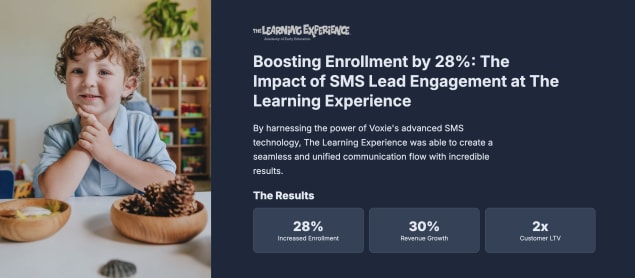
The goal was simple: get more locations texting like their best locations, without asking every employee to become an expert at lead follow-up. And it worked. Voxie power-user locations saw a 28% increase in student enrollment from 2023 to 2024. The Learning Experience also reported 30% revenue growth and 2x customer lifetime value.
We did an easy integration with Voxie to pull our contacts from our CRM. That has been a huge time saver for our 300+ centers. - Christian Manzano, Marketing Director, The Learning Experience
Best Practices to Remember When Crafting Text Systems for Schools
- Allow parents to subscribe to lists that matter to them: This shouldn’t come as a shocker—some parents want to be more involved than others. Give parents the freedom to choose which notifications they receive. Perhaps they want to receive reminders for every upcoming football game . . . or perhaps they’d rather stick solely to emergency alerts. Importantly, only message those who have opted in to certain lists, and provide clear opt-out instructions: “Reply STOP to unsubscribe.”
- Be clear and concise: For example, instead of “We would like to remind you that there is a meeting scheduled for next week,” try “PTA meeting: Wed, 6pm, Library.” For more tips on how to shape your messages, read Craft the Perfect Marketing SMS - Content Writing Tips.
- Time it right: Send messages during appropriate hours—no one wants a 6am wake-up text.
- Practice restraint: Remember, your mass texts are there to be helpful to the recipients. If overused for announcements both big and small, your school’s SMS program crosses the line from convenience to nuisance. Prioritize only the most important and time-sensitive messages to ensure your texts remain valuable and welcomed.
What to Look For in an SMS Platform
Choosing the right SMS platform is crucial for schools aiming to communicate effectively and securely. Here’s what to prioritize:
- Ease of use: An intuitive dashboard makes it simple for school staff to text, manage lists, and schedule campaigns with minimal training. After all, they don’t have time to navigate complicated systems or troubleshoot confusing interfaces—they need a tool that just works, right out of the box.
- Integration capabilities: Connect with your existing student information systems (SIS), calendars, and other school management tools for seamless communication.
- Group segmentation: Target messages to specific classes, grades, extracurricular groups, or interest-based lists for maximum relevance. Ideally, your SMS platform should also integrate with your student information systems, ensuring that contact lists automatically update as students advance, join new extracurriculars, and eventually graduate.
- Role-based access controls: Assign different permission levels to staff, ensuring only authorized users can send messages or access sensitive data.
- Message templates: Use and customize pre-built templates for common scenarios like attendance alerts, event reminders, or emergency notifications.
- Message guardrails and approval workflows: Schools should be able to establish rules around tone, required information, sending frequency, and who can approve messages.
- Two-way communication: Enable recipients to reply, ask questions, confirm attendance, or provide feedback directly via text. More importantly, such communications should be saved for administrators to review as needed.
- Automation and scheduling: Set up automated reminders for events, deadlines, or recurring notifications, and schedule messages in advance.
- Data security: Ensure the platform meets strict privacy standards and complies with regulations like FERPA to protect student and family information.
- Analytics and reporting: Track delivery, open rates, response rates, and text engagement to measure impact and refine your school’s communication strategy.
- Opt-in/opt-out management: Make it easy for families to subscribe or unsubscribe from messages, and manage consent efficiently.
- Customer support: Easy access to responsive technical support and training resources to help staff get the most out of the platform.
Level Up Your School’s SMS With Voxie
Voxie is an SMS and text messaging platform that helps schools manage mass alerts, automated reminders, two-way parent conversations, and targeted messaging from one system. Schools can segment audiences, automate behavior-triggered texts, integrate messaging with existing systems, and give administrators and staff different levels of access based on their roles.
Voxie also brings AI into day-to-day communication. Intelligent Inbox helps staff prioritize conversations that need attention, while automated responses and customizable workflows can handle routine follow-ups without adding more work to already-busy teams.
Whether you’re sending an emergency alert across the school system or following up with one parent, Voxie gives schools the tools to make texting faster, more consistent, and easier to manage at scale.
🎓
Schedule a demo to see how Voxie can support your school’s text messaging strategy.
Frequently Asked Questions About School Text Messaging Services
Should multi-location school systems or campuses have separate SMS accounts for each location?
No. Separate accounts can make it much harder for administrators to see what is being sent, how quickly families are receiving responses, and whether different schools are following the same communication standards. A centralized platform like Voxie lets individual locations or campuses manage their own conversations and subscriber lists while giving system-level administrators visibility across the organization. Permissions can then determine exactly what each user is allowed to see and do.
Do parents need to download an app to receive school texts from Voxie?
No. Parents receive Voxie messages as normal SMS or MMS texts on their phones, so there is no parent-facing app to download or separate portal to check. They can also reply directly to the text when a school enables two-way communication.
If a parent needs to talk to a staff member ASAP, how does Voxie know whether to answer automatically or involve a person?
Schools can determine which kinds of conversations Voxie should handle automatically and which should reach a person.
The key is Voxie’s Conversational Intelligence, which interprets the intent and tone of incoming messages with 98% accuracy. This allows it to correctly determine whether addressing the query directly or forwarding it to your team, all based on your specific guidelines. This means a neutral question about school pickup times might receive an immediate automated response, while a frustrated message about that same issue could be routed to a staff member for personal attention.
What phone number do school texts come from?
Texts to parents won’t come from an unfamiliar national number. Voxie can text-enable an existing local phone number, allowing a school or campus to send and receive SMS through a number families already recognize without disrupting regular voice calls. That also means a larger school system can communicate centrally while messages still appear to come from the appropriate local school or campus.
Manually keeping contact lists up to date is a problem for our staff. How does Voxie handle this?
Schools don’t have to rely on someone periodically cleaning and rebuilding spreadsheets. Voxie can integrate with existing data systems so contact information, attributes, subscriber status, and audience lists can flow into the platform automatically. Voxie supports integrations through APIs, webhooks, scheduled file transfers, databases, and platforms such as HubSpot and Salesforce, making it possible to build the connection around the systems an organization already uses. The result is less manual list maintenance and a much lower chance that outdated information determines who receives a message.

About the Author
Ali Spiric
Growth Marketing Manager at Voxie
Ali Spiric is the Growth Marketing Manager at Voxie, an SMS marketing platform built for franchise and multi-location brands. Her work puts her in daily contact with the campaign data, customer results, and messaging trends shaping how franchises use text. She has 7+ years of marketing experience focused on measurement and revenue attribution, and her writing has been cited in Forbes.